


2025 Technology & IT Modernization Report for Mid-Sized Businesses
Understanding the current state of IT modernization, emerging technology adoption, skills challenges, and strategic priorities shaping the future of mid-sized organizations (101-1,000 employees).
Research Methodology
400 IT Decision-Makers
Comprehensive survey of IT leaders
Mid-Sized Businesses
Organizations with 101-1,000 employees
95% Confidence Level
±4.9% margin of error
May-June 2024
Survey conducted by Drive Research & TierPoint
Scroll to explore the comprehensive data
Report Navigation
Jump to any section of the comprehensive analysis
Shareable Statistics & Key Insights
Quick access to the most impactful statistics from our comprehensive research. Each insight includes context about the business challenge and strategic implications for mid-sized organizations.
Emerging Technology Adoption
Security & Compliance
Skills & Talent Crisis
Cloud Strategy & Budget Management
Business Continuity & Resilience
Executive Summary
As organizations expand their IT operations or adopt new technologies, they encounter a new set of IT complexities and challenges. A recent TierPoint survey of over 400 IT leaders highlights these challenges, particularly regarding emerging technologies like AI. An overwhelming 99% of leaders acknowledge the importance of these technologies and plan to implement them. However, two-thirds of respondents report significant IT staffing challenges, citing skill gaps in AI and related technologies that severely hinder their ability to adopt these innovations and pursue broader IT modernization efforts.
In addition to staffing, cost optimization and business continuity are critical concerns. The use of cloud technologies continues to rise, with 72% of respondents planning to expand their cloud services over the next two years. Despite implementing cost-saving measures, only 29% of organizations find these efforts fully effective, leading many to consider cloud repatriation to regain control over escalating expenses.
Business continuity remains a top priority for companies of all sizes. Although 74% of respondents have implemented additional safeguards against IT disasters, only 35% feel fully confident in these protections. This uncertainty persists despite 53% of organizations enhancing their cybersecurity efforts. Ensuring confidence in disaster preparedness and maintaining seamless operations in the face of potential disruptions are ongoing challenges that require attention.
IT Modernization
Technology change remains a constant in enterprise IT, often requiring organizations to upgrade their infrastructure to meet evolving demands or enhance their capabilities. These upgrades improve efficiency, security, product and service quality, and user experiences. Our survey focused on key components of IT modernization: prioritization, motivation, and improvement.
These elements are interconnected. For instance, respondents prioritizing cybersecurity are motivated by security concerns, driving them to adopt new technologies and upskill internal resources to support these advancements. This synergy highlights how prioritization and motivation play crucial roles in shaping IT modernization strategies.
Prioritization
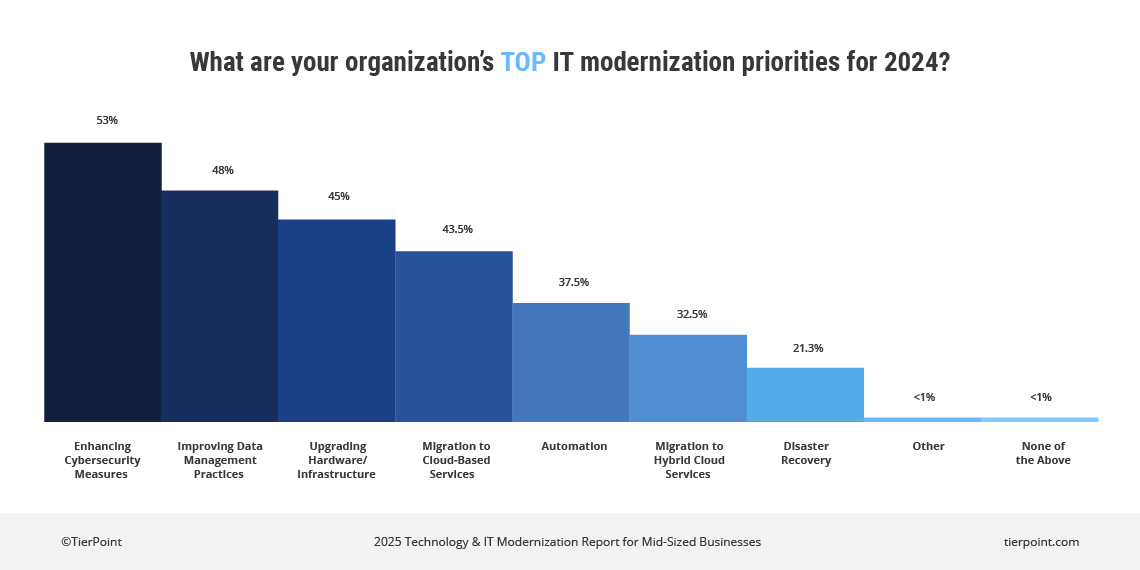
Despite differences between small and large organizations, there is notable alignment in IT modernization priorities. Enhancing cybersecurity measures tops the list, with 53% of organizations focusing on this area. Organizations modernize their IT infrastructure for improved security due to the prevalence of data breaches and ransomware attacks, which often stem from outdated systems and software.
Improving data management practices follows closely, prioritized by 48% of respondents. As businesses grapple with an increasing number of internal and external data sources, they find that efficiently organizing and managing data has become critical. This priority reflects the growing complexity of data ecosystems in modern businesses.
Upgrading hardware and infrastructure ranks third at 45%, supporting the goals of enhanced cybersecurity and improved data management. Closely related is the fourth priority: migration to cloud-based services, cited by 44% of respondents. Knowing 94% of companies globally use cloud software (according to a report from Colorlib), this focus aligns with the broader trend of cloud adoption as a crucial element for business growth and IT modernization.
Motivation
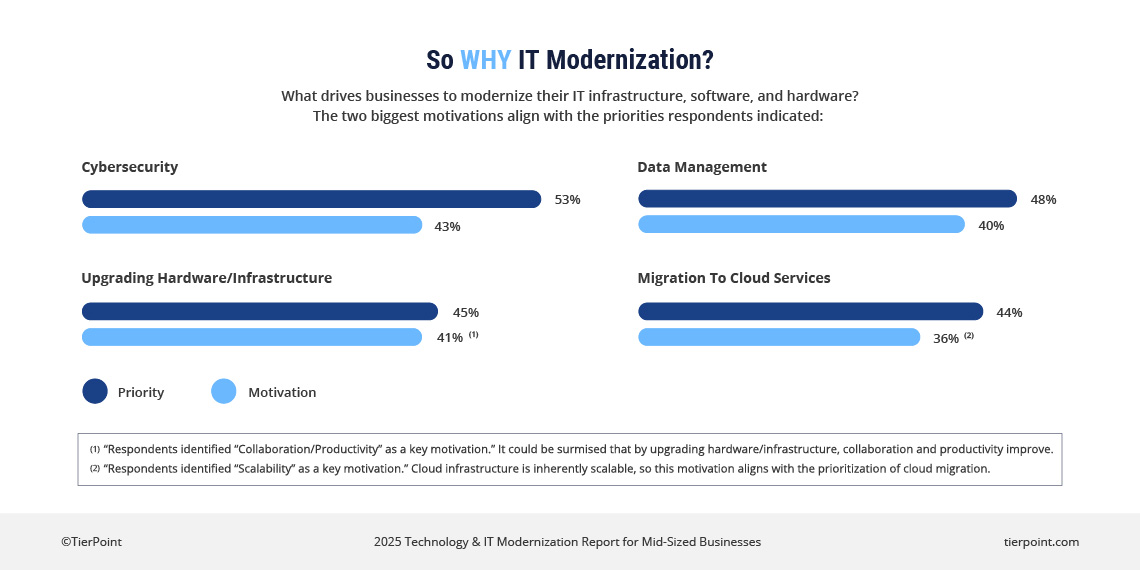
In addition to those alignments, 36% of respondents also indicated that "customer experiences" were a motivation for IT modernization.
The Challenges in IT Modernization
IT modernization, though, is fraught with challenges. Respondents indicated several different obstacles:


Tech Innovation
A core component of IT modernization is improving the software and hardware that make up the business computing infrastructure. This process may involve simply upgrading existing infrastructure, which includes replacing current equipment or software with new or comparable versions, such as cloud solutions. It can also entail integrating newer or cutting-edge technologies.
Integrating these technologies provides enhanced functionality that can improve business operations and competitiveness. Our survey respondents addressed these new technologies across three vectors: technology types/strategies, motivation for adoption, and supporting new technologies.
Technology Types & Strategies
In our survey we looked at a cross-section of technologies and/or technology strategies. In short, 99% of IT decision-makers plan to adopt or invest in emerging technologies and strategies for their organization over the next 12 to 24 months. The table below indicates the types of technologies or technology strategies and the respective percentage of respondents indicating their intent to adopt.

Interestingly, some technologies and strategies align with the priorities and motivations in IT Modernization. For instance, 44% of respondents prioritize "cloud migration" in their modernization plans. Additionally, AI and machine learning are increasingly applied in cybersecurity, with many providers using these technologies to automate monitoring and threat identification.
Additionally, AI and machine learning are increasingly applied in cybersecurity, with many providers using these technologies to automate monitoring and threat identification.
Motivation for Adoption
Evaluating new technologies is a crucial aspect of any IT organization. However, this process demands resources and strategic guidance. Therefore, understanding the factors that influence the technology choices of IT decision-makers in small and medium-sized enterprises is essential.


Supporting New Technologies
While adopting new technologies can significantly help the business, they also come at a cost. Businesses must develop a strategy for supporting these technologies. Without a clear strategy, organizations may implement technologies incorrectly or fail to operationalize them effectively, undermining the support employees need to use these tools.

A noteworthy observation shows how some of the support plans align with general IT modernization. For example, the first and third graphs align with the IT modernization priority of "upgrading/hardware infrastructure" (45%).
Skills Shortages
Skills are crucial for IT modernization and technical innovation. Without expertise in areas like cloud migration and optimization, efforts can fail, leading to increased costs and reduced productivity. However, these skills are scarce. IDC predicts that by 2026, over 90% of organizations will experience an IT skills crisis, resulting in $5.5 trillion in losses due to product delays, impaired competitiveness, and loss of business. Unsurprisingly, 97% of survey respondents report feeling the impact of this shortage to varying degrees.
Over 87% of respondents indicated that these skill shortages will, at the least, have a moderate to severe impact on the business (64% indicated at least a major impact). Therefore, the perceived difficulty in finding specific skills among prospective new hires aligns with the new technologies and IT modernization initiatives they aim to accomplish.
Additionally, 37% of respondents reported difficulty finding cybersecurity skills. As highlighted in this report, cybersecurity is crucial for many businesses, and the IT skill shortage could jeopardize these initiatives.

Cost Optimization
As highlighted in the Tech Innovation section, reducing IT costs is a key driver for 38% of respondents adopting new technologies. While cloud services offer significant productivity and security benefits, managing costs effectively is crucial.
Our research found that 40% of IT budgets are allocated to cloud platforms, SaaS, and infrastructure, underscoring the need for cost optimization strategies to maximize cloud investments.
72% of respondents expect their IT budgets for cloud services to increase over the next two years, underscoring the industry's reliance on cloud technologies despite rising costs. To manage these expenses, 73% have implemented cost-saving measures, with 83% finding them effective.

Business Continuity & Data Protection
As mentioned in the prioritization subsection of the IT Modernization part of this report, businesses relying on multiple data sources must ensure business continuity and data protection.
Interruptions can severely impact operations and revenue, whether caused by hackers or data corruption. This underscores the importance of having robust, regularly tested continuity and protection plans.
According to our respondents, 3 out of 4 organizations (74%) reported implementing a mix of additional measures over the past 12 months to ensure business continuity and data protection. These measures included a variety of approaches including:

86% percent of respondents are confident in their organization's ability to recover critical data and systems after a disaster though only 35% feel fully confident. This suggests a reliance on multiple solutions —hardware, software, people, and processes— which adds complexity. To manage this, 65% of organizations conduct continuity tests at least once a month.
Conclusion
This study highlights several critical challenges and opportunities for organizations aiming to modernize their IT infrastructure with their existing in-house resources. Key issues include IT talent shortages, cloud cost optimization, business continuity, and cybersecurity. These challenges are interconnected and significantly impact the ability of businesses to adopt emerging technologies like AI and cloud computing effectively.
The study reveals that while organizations are eager to implement these technologies to enhance productivity and reduce costs, they often face difficulties due to a lack of skilled IT professionals. Additionally, managing cloud expenses and ensuring robust disaster recovery and cybersecurity measures remain top priorities for IT leaders. A Managed Services Provider (MSP) can play a crucial role in addressing these challenges by offering strategic support and expertise.
MSPs can help address IT skills challenges by providing access to experienced professionals who can implement and manage new technologies. They can also assist in developing a comprehensive cloud strategy that includes cost optimization measures and the integration of AI and ML technologies. Moreover, MSPs offer robust disaster recovery solutions and advanced cybersecurity measures, ensuring business continuity and data protection.
By partnering with an MSP, organizations can enhance their IT capabilities, optimize costs, and ensure a secure and resilient IT environment, enabling them to focus on innovation and growth.