


Published: February 11, 2026 | Last Updated: March 4, 2026
Top Trends for AI in Data Management in 2026

Table of Contents
How can businesses derive value from growing mountains of data? With data generation expected to more than triple between 2024 and 2029, artificial intelligence can serve as an ideal counterpart to existing data management processes.
AI-driven approaches can help organizations operate more effectively and efficiently, while surfacing deeper insights. We’ll cover how IT leaders use AI in data management, its benefits, and trends to look out for in 2026.
What Is AI in Data Management?
AI in data management refers to the use of artificial intelligence and machine learning to automate key processes in the data lifecycle. It can include the use of autonomous agents, predictive analytics, and natural language processing (NLP), both in cloud computing and on-premises frameworks.
While traditional data management is typically more passive, relying on rule-based systems, manual processes, and human expertise, AI-powered systems can take a more active, policy-guided, and semi-autonomous role, detecting issues early and recommending or executing corrective actions within defined guardrails.
Ultimately, automation in data management reduces errors and streamlines processes, empowering businesses to put more time and resources into value-added activities.
How Is AI Used in Data Management?
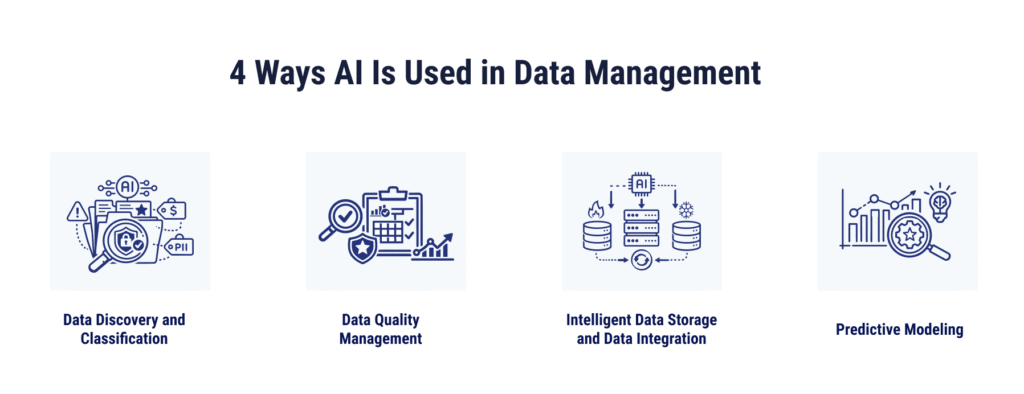
Businesses can leverage AI solutions across the data lifecycle, from data discovery and classification to predictive modeling. Key use cases can include data classification, data cleaning, intelligent storage.
Data Discovery and Classification
Data is only valuable if it is accessible and understandable to the people who need it. This is done through proper identification, classification, and cleaning of an organization’s data.
AI can support these processes by automatically identifying sensitive, redundant, or high-value information, making it easier to protect, remove, or prioritize data. For businesses that deal with personally identifiable information (PII), AI can be trained to recognize and tag data that needs to meet certain compliance standards.
Generative AI systems can also rapidly create and enrich metadata, describing where data came from, what it is, and who owns it.
Data Quality Management
In addition to removing redundant data and prioritizing sensitive data, AI can use the rules of your datasets to identify anomalies and ensure quality. This can automate data cleansing, data validation, and continuous data quality monitoring.
Instead of just checking whether a field is empty, AI can validate whether the data makes sense in context, even streamlining quality checks to improve data reliability and the accuracy of data analysis. This monitoring can be done continuously, so if the quality starts to degrade, AI-driven tools can catch and address issues quickly.
Intelligent Data Storage and Data Integration
Once data has been identified and cleaned, AI can support intelligent data storage and integration. Where data lives and how it moves is no longer a static practice. AI can help organizations optimize data placement using smart tiering, bringing frequently accessed data to “hot” tiers and moving rarely used data to “cold” tiers.
AI can also greatly aid data integration. Instead of data existing in fragmented silos, AI can bridge the gap with automated data mapping or by adjusting integration flows to accommodate changes in schema structures. These automations enable a more unified view of information that organizations can use for further data analysis.
Predictive Modeling
In competitive markets where technology is constantly shifting, reducing the time it takes to analyze data and take action can often give businesses an edge. In the output stage of the data management cycle, predictive modeling can drive more informed decision-making processes through trend forecasting, anomaly detection, and data synthesis.
AI can analyze historical data to predict future outcomes, quickly detect fraud or other aberrant behavior, and use statistically accurate synthetic data to train models to respond properly in new environments. AI takes on the analytical heavy lifting. As a result, organizations can reach important insights, reduce risk, and improve customer experiences faster.
What Are the Benefits of AI Data Management?
AI can play an important role in effectively managing the growing volumes of information worldwide, both in the cloud and on-premises frameworks. It provides a set of tools organizations can use to unlock value in their data and achieve operational efficiency.
With AI data management, businesses can:
- Automate mundane, otherwise manual tasks to streamline processes and save time
- Reduce storage costs by automatically moving data to relevant tiers
- Auto-correct mapping, deduplicate data, and form insights in real time
- Democratize access to data by implementing natural language interfaces
- Automate the discovery of personally identifiable information (PII), ensuring data is encrypted or protected in a compliant manner
- Automatically vectorize unstructured data to make it ready for models and AI agents
- Improve real-time monitoring and threat identification for improved data security
- Form real-time insights to help businesses innovate, reduce operational costs, or improve the customer experience
In many ways, artificial intelligence gives companies a competitive edge and a head start toward pursuing innovative new projects.
6 Top Trends in AI-Powered Data Management for 2026
In 2026, businesses should consider investing in the following AI data management trends, which can help them reap the aforementioned benefits and make the most of the wealth of data at their fingertips.
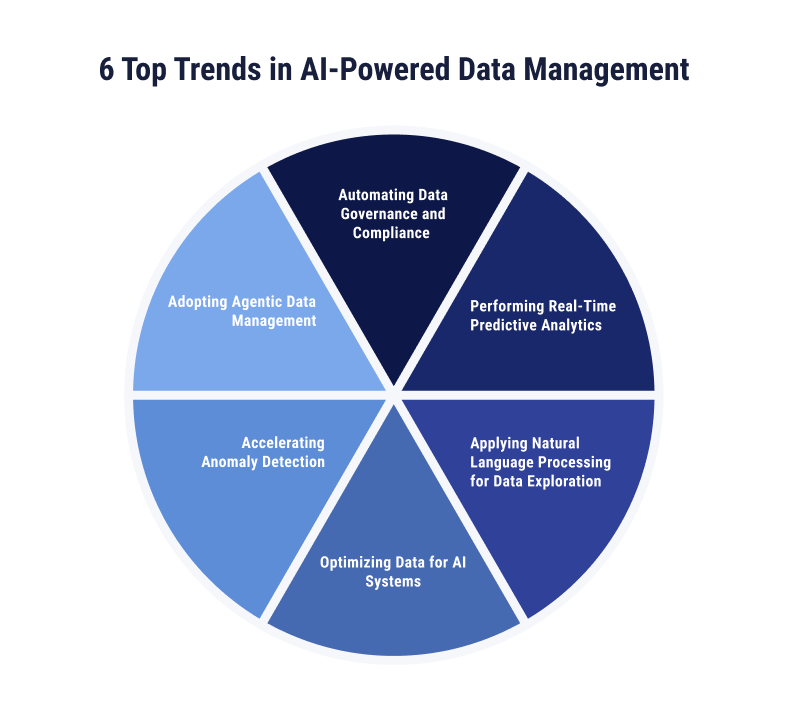
1. Automating Data Governance and Compliance
Instead of reacting to breaches and compliance issues, AI-powered data governance measures can prevent issues before they occur. Processes like data access control, audit logging, and lineage tracking can all integrate AI solutions.
Using AI tools, organizations can anonymize sensitive data, identify potential security risks from anomalous behavior, and automatically restrict data access if suspicious activity is identified. These advanced technologies can even be used to map evolving regulatory standards to existing data controls, ensuring that changing standards or new data management practices don’t alter compliance.
2. Performing Real-Time Predictive Analytics
Sometimes, even savvy business leaders don’t see what’s coming down the road before it’s too late. In addition to automating data analytics to identify past and present trends, AI is increasingly helping organizations take a proactive stance by predicting what is likely to happen. For example, it can alert teams about anticipated inventory depletion, upcoming maintenance needs, and early signs of fraudulent activity.
Predictive models that are pushed to the edge of a network can reduce the lag associated with processing, giving teams real-time feedback to make quick, data-driven decisions and improve operational effectiveness.
3. Applying Natural Language Processing for Data Exploration
With natural language processing (NLP), users can query complex databases without intimate knowledge of SQL or Python. They may ask a question like “What are our Q3 earnings in 2025 compared to 2024, and how does that look based on geographical region?”, and the NLP-powered engine could respond with the subsequent data.
NLP makes it easier for humans to explore datasets accessibly and intuitively. NLP can also automate text summarization, find topics and themes in data, categorize named entities, and conduct sentiment analysis.
4. Optimizing Data for AI Systems
In 2026, organizations need to think about how to store data for both humans and AI models. IT teams are gearing up for AI advancements by making data “agent-ready,” so it can be accessed and analyzed by automated tools.
This can involve converting unstructured data in a data lake into vector embeddings, therefore making data readable to large language models (LLMs). This can also include using synthetic data, AI-generated data that resembles what’s in a given environment, to train and refine current models without risking the privacy of real user data.
Sheelu Verma, a leader in building AI-ready data platforms, describes the importance of these initiatives in Ep. 28 of our Cloud Currents podcast:
“If you feed garbage into your AI models, you get garbage out. You need to have trustworthy, clean, governed data so that you can get accurate information out to the business for decision making… [Data governance] is an extremely important function for getting AI readiness for your company.”
Sheelu Verma, Director of Data Governance and Cloud Operations at ADT
5. Accelerating Anomaly Detection
Anomaly detection is evolving beyond simple alerts and is now part of more sophisticated threat detection and response efforts. By deeply understanding your data’s baseline, AI models can distinguish between normal behavior and strange signals, triggering automated alerts and containment processes.
In addition to identifying bad actors, these capabilities can also apply to predictive maintenance. Models can spot minute differences that may be early indications of machine failures. Anomaly detection can help with data continuity and availability, ensuring that critical data won’t be compromised or disrupted by a breach.
6. Adopting Agentic Data Management
With agentic AI, artificial intelligence systems move from the role of assistant to key actor. Agents can manage end-to-end workflows, shifting code and orchestrating agents to maintain the data lifecycle. As this technology advances, it’s expected to significantly reduce the time needed by human workers, who can then shift their focus to more strategic, nuanced projects.
Unlock the Power of AI in Data Management with TierPoint
Managing a vast amount of data can be challenging, but the right AI-enabled data management tools can simplify the complex. TierPoint’s AI advisory and consulting services can help you better navigate and leverage your in-house data, unlocking its true power and potential. Contact our advisory team today to start exploring how AI can transform your data management practices.

FAQs
AI can improve data management by automating tasks like tagging, categorizing, and data cleansing, improving the speed and accuracy of data handling. AI tools can also detect anomalies and predict patterns based on previous data, spotting trends in significantly less time compared with human analysts.
The 10-20-70 rule is a change management standard for integrating AI in an organization. It states that 10% of the effort should be spent on algorithm building, 20% should be spent on infrastructure for technology and data, and 70% should be spent on working with people and transforming key business processes. While some may think that the technology itself is the most important part of implementing AI, it’s actually changing the people and processes that matters most.
Robust data governance frameworks are vital for organizations looking to protect their data. This can include encryption, access controls, and data masking that obscures and protects sensitive information. Organizations should also conduct regular audits to ensure that AI models are compliant with relevant regulations such as CCPA and GDPR.
Table of Contents