


Table of Contents
Database modernization is a critical step in strengthening availability, performance, and compliance. However, organizations can take a variety of approaches to upgrade their data systems. For many, these include adopting managed database services, improving resiliency and recovery, and reducing ongoing operational work like patching and manual tuning.
The key is planning. Databases sit at the center of applications and integrations, so every change must protect data integrity and minimize downtime. This article outlines the benefits and challenges of modernization, as well as best practices to reduce risk and generate long-term value.
What Is Database Modernization?
Database modernization is the process of updating how your organization runs, scales, secures, and supports databases to meet today’s requirements for performance, availability, compliance, and cost control. It goes beyond upgrading a database version or moving to new hardware. Modernization typically involves improving the database platform, the architecture behind it, and the operating model used to manage it day to day.
In practice, database modernization can take several forms. Organizations may modernize by:
- Moving from self-managed environments to managed database services to reduce patching, backups, and operational overhead
- Changing the database engine or data model (for example, moving to PostgreSQL-compatible platforms, adopting NoSQL for specific workloads, or adding purpose-built databases like time-series or graph)
- Strengthening security and governance controls
- Improving resiliency and recovery
- Enabling more scalable patterns such as read scaling, caching, or multi-region designs
The goal is to ensure the database supports the business. Modernization can support outcomes such as more reliable customer experiences, safer handling of sensitive data, faster delivery of new features, and a stronger foundation for analytics and artificial intelligence (AI).
Why Is Modernizing Databases Important?
Modernizing databases is important because databases sit at the center of the applications that run your business. When database platforms lag behind modern requirements, the impact shows up everywhere: slower customer experiences, higher outage risk, security exposure, and escalating operational cost.
Performance is only part of the challenge. In many legacy systems, the biggest issue is operational fragility. Manual patching, inconsistent configuration, limited visibility into query behavior, and untested restore processes can make reliability dependent on tribal knowledge. As data volumes grow and more systems integrate with the database, small issues can turn into major incidents.
Modernization helps teams shift to a more resilient and controlled operating model. It makes it easier to implement consistent security and governance practices (such as encryption, auditing, and role-based access), define measurable recovery time and point objectives (RTO/RPO), and scale performance to match changing workloads. It also reduces day-to-day toil by standardizing monitoring, maintenance, and backup strategies, freeing teams to focus on higher-value work.
Finally, modernization creates a stronger foundation for what businesses increasingly expect from data: faster insights, more reliable integrations, and the ability to support modern application patterns. When operational data is trustworthy, recoverable, and well-governed, teams can adopt new capabilities, like near-real-time reporting and AI-enabled experiences, with less risk.
Key Benefits of Modern Databases
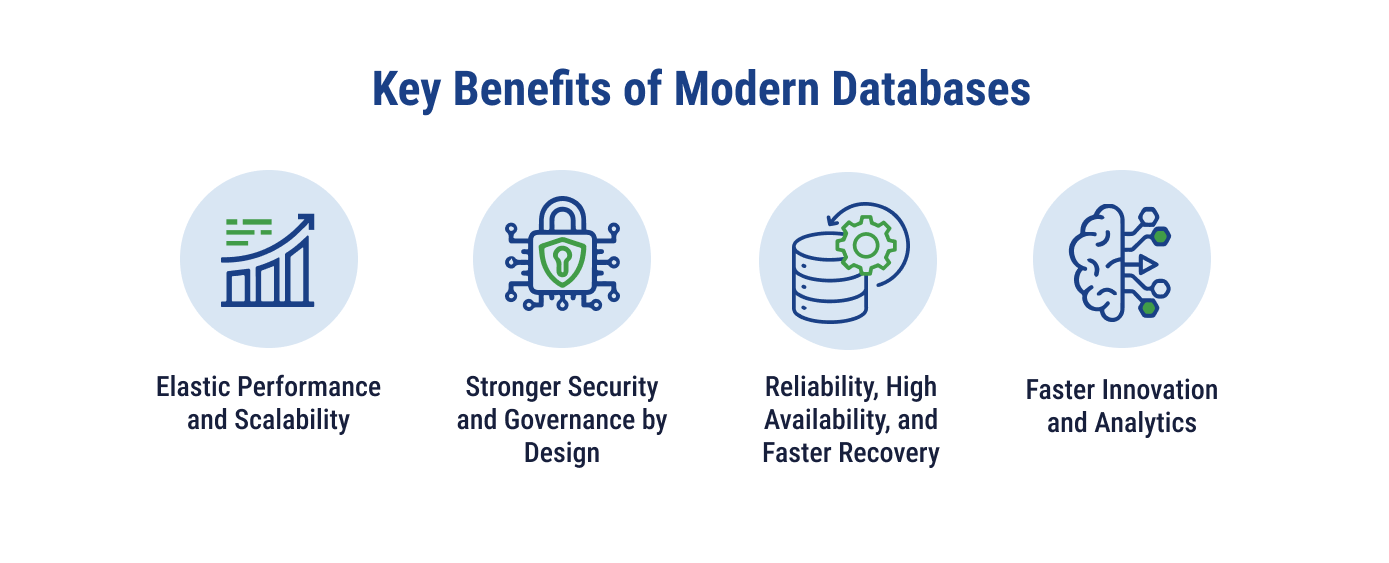
Modern databases aren’t just newer versions of the same technology. They’re designed to reduce operational risk, strengthen security controls, and support modern application demands. The biggest gains typically show up in resiliency, governance, performance at scale, and the ability to move faster with data.
Elastic Performance and Scalability
Modern workloads are rarely steady. Demand spikes, new integrations appear, and query patterns change. Modern databases support scalable patterns like read scaling, caching, and capacity options that can better match variable workload needs. This helps teams maintain predictable latency and throughput while avoiding long-term overprovisioning, which improves both performance consistency and cost efficiency.
Stronger Security and Governance by Design
Databases store an organization’s most sensitive and regulated data, so modernization often starts with improving security posture. Modern platforms support more standardized controls such as encryption, detailed auditing and logging, and role-based access that aligns with enterprise identity practices.
Modernization also supports configuration automations and repeatability. This can reduce “configuration drift” and one-off exceptions, making compliance readiness and security operations more repeatable over time.
Reliability, High Availability, and Faster Recovery
Modern database platforms make it easier to design for uptime and respond to failures without relying on fragile, manual processes. Common modernization improvements include more consistent backup and restore practices, replication options, and more predictable failover strategies. For technical teams, that means clearer recovery objectives (RTO/RPO), fewer maintenance-related outages, and a more resilient foundation for critical applications.
Faster Innovation and Analytics
Modern applications have demands that can exceed the capabilities of traditional databases. Specialized database engines can be optimized for specific use cases. For example, Amazon TimeStream is designed for time-series data, and Azure Cosmos DB is optimal for NoSQL documents.
Modern data architectures can also break down data silos to help organizations make well-informed decisions. These specifications allow for faster innovation and enable advanced data analytics.
What Are Common Challenges in the Database Modernization Process?
During the database modernization journey, businesses may encounter challenges related to application dependencies, data integrity, downtime, security, governance, and skills gaps.
Application Dependencies and Database Behavior Mismatches
Databases are rarely standalone. Applications may rely on specific query behavior, stored procedures, transaction isolation levels, connection pooling patterns, or even undocumented quirks in the current environment. During modernization, these hidden dependencies can show up as performance regressions, timeouts, or functional issues that weren’t obvious during initial testing.
Data Integrity, Validation, and Cutover Downtime
Moving data is the easy part. Proving it’s correct and cutting over safely is harder. Teams need a plan for data validation (row counts, checksums, reconciliation rules, sampling) and a strategy for cutover that minimizes downtime and supports rollback if needed. Without rigorous validation and a tested backout plan, small inconsistencies can turn into major business-impacting incidents.
Security, Access Control, and Governance Gaps
Database modernization often improves security long-term, but the transition period can introduce new exposure. The risk is especially high if roles, network controls, secrets management, encryption settings, and audit logging aren’t defined early. Cloud and managed platforms don’t automatically make an environment secure, so teams still need to design access policies, enforce least privilege, and ensure visibility for compliance requirements.
Skills Gaps
Modern platforms change how databases are operated. Teams may need new skills, including expertise in:
- Automation and infrastructure as code (IaC)
- Observability
- Cost governance
- Performance tuning in cloud environments
If ownership is unclear, or if an “accidental DBA” ends up responsible, organizations can struggle with stability, data security, and optimization after the migration is complete.
Best Practices for Successful Database Modernization
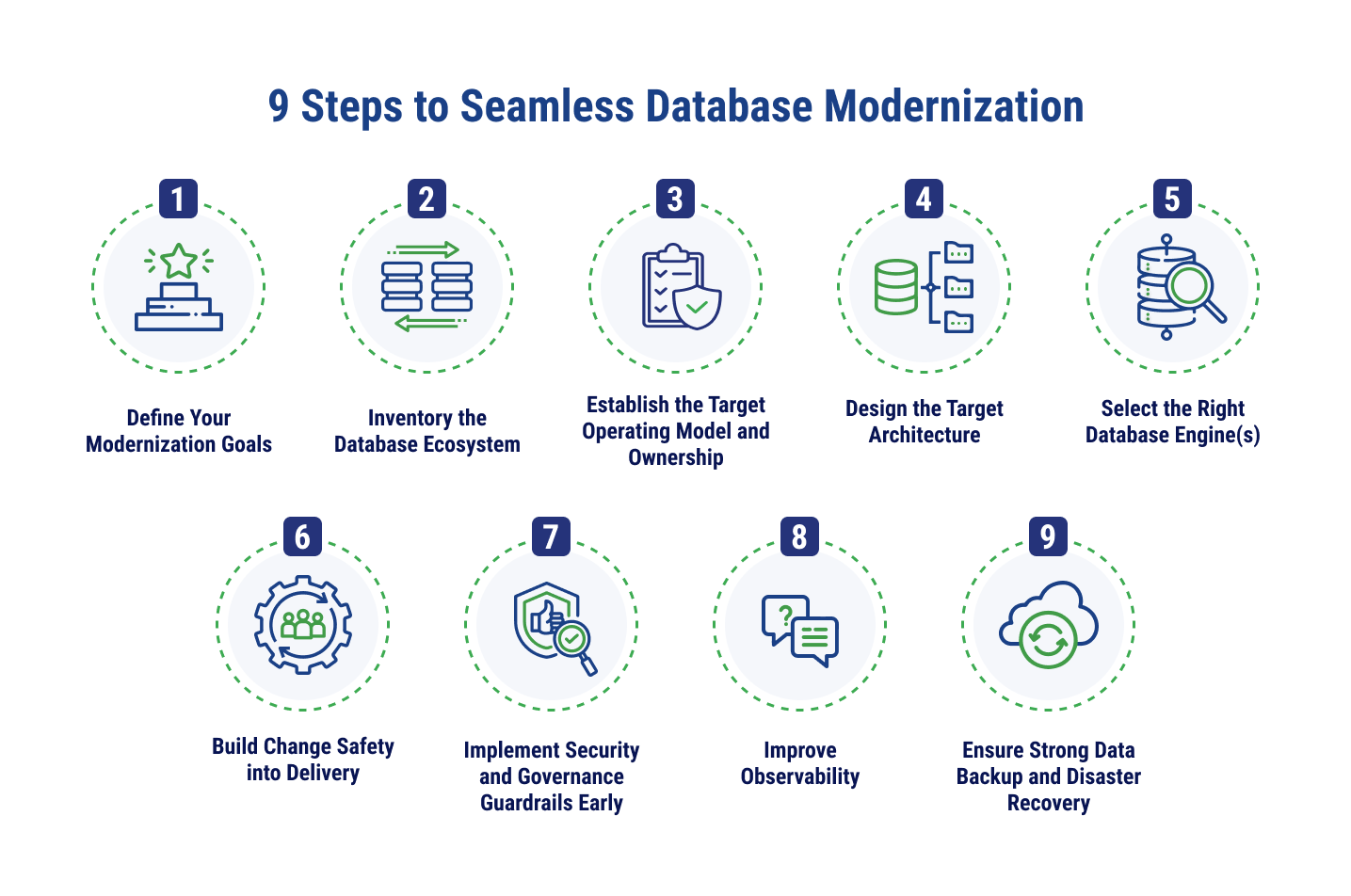
Database modernization is most successful when it’s approached as an operating model upgrade, not a one-time migration. The best plans define measurable outcomes, modernize the architecture where it matters, and put guardrails in place so performance, security, and cost stay healthy long after go-live.
Define Your Modernization Goals
Start with identifying measurable targets tied to business outcomes. For example, you may outline your availability and service level objectives (SLOs), latency and throughput goals, RTO/RPO, security requirements, and cost expectations.
These success metrics become your decision filter for architecture, tooling, and tradeoffs. They also prevent “modernization” from turning into an open-ended project.
Inventory the Database Ecosystem
To prevent performance issues and downtime, map all dependencies that commonly break projects: applications, ETL/jobs, reporting tools, authentication, network paths, batch windows, and downstream consumers. Include “behavioral” dependencies such as stored procedures, triggers, transaction semantics, and connection patterns.
This step supports a smoother transition by strengthening visibility, allowing potential issues to be proactively addressed.
Establish the Target Operating Model and Ownership
Database modernization is both a technology decision and operating model decision. Before choosing database platforms or migration tactics, align on who will run the database day to day and how responsibilities will be handled after go-live. This prevents common post-modernization gaps like unclear patch ownership, inconsistent backup testing, or “who’s on call?” confusion.
Common operating model options include:
Self-Managed (IaaS / VMs)
You run the database software on virtual machines and own patching, backups, monitoring, high availability and disaster recovery (HA/DR) configuration, and tuning.
Best for: Highly customized environments, special extensions, legacy constraints, strict control needs.
Managed Database Service (PaaS / DBaaS)
The database management services provider takes care of most of the undifferentiated work, such as maintenance automation, backup primitives, and built-in HA patterns. You manage schema, queries, data access policies, and usage.
Best for: Most modernization efforts focused on reducing operational burden and improving reliability.
Hybrid Operations
Standardize most workloads on managed services, while keeping a small set self-managed for specialized requirements.
Best for: Mixed portfolios and phased modernization roadmaps.
Partner-Managed Operations
A managed services provider supports monitoring, incident response, performance optimization, patch coordination, backups, and DR testing, often across environments and clouds.
Best for: Skills gaps, 24/7 requirements, or teams that want to offload operational overhead.
Design the Target Architecture
With your operating model defined, design the target database architecture around your success metrics, especially availability, recovery, performance, and cost. This includes deciding how you’ll handle high availability, failover behavior, backup and restore patterns, and how the system will scale as demand changes.
For many teams, modernization also includes adding patterns that reduce pressure on the primary database, such as read scaling, caching, and partitioning. If you have strict regulatory compliance or latency needs, you may also need to account for data residency, multi-region recovery options, or regional traffic routing.
The goal is a design that’s resilient by default, observable in production, and aligned to how you plan to operate it long-term.
Select the Right Database Engine(s)
After you’ve defined how the database will be operated and what the architecture needs to support, choose the database technology (or mix of technologies) that best fits your workloads. Modernization doesn’t require replacing everything with one “perfect” database. Many organizations keep a primary relational system for transactional integrity and introduce purpose-built databases or patterns only where they deliver clear benefits.
Instead of framing this as SQL vs. NoSQL only, base the decision on practical factors. These include:
- Consistency requirements
- Query patterns
- Latency expectations
- Data shape
- Growth rate
- Integration needs.
The most successful modernization programs standardize around a small set of approved engines and patterns, so teams can move faster without creating a new operational snowflake every time a new application launches.
Build Change Safety into Delivery
Modern databases live in a continuous delivery world, and the riskiest changes are often schema changes and query behavior changes, not in the infrastructure. Establish a repeatable process for version-controlled schema updates, backward-compatible changes, and performance testing that reflects real traffic patterns.
Also plan for rollback. Even with a phased approach, teams need a documented backout strategy and clear criteria for when to pause or revert. Change safety is what keeps modernization from becoming a high-stress, high-risk event, and it’s a major driver of faster, safer releases over time.
Implement Security and Governance Guardrails Early
Whether you decide to run self-managed databases, adopt managed services, or use a partner-managed model, modernization is the moment to standardize security and governance. Before you scale the new platform, define:
- Access policies (least privilege and role-based access)
- Encryption requirements
- Secrets management practices
- Audit logging and retention policies
This is also a good time to reduce long-term risk by removing legacy exceptions: over-privileged accounts, shared credentials, and inconsistent logging configurations. Strong guardrails are what make a modern database environment easier to manage and easier to prove compliant, without reducing agility or slowing teams down.
Improve Observability
Database modernization is measurable. Establish baseline performance and reliability metrics in the current environment, including latency, query performance, error rates, connection utilization, replication lag, and storage growth. Then, compare those same indicators after changes are introduced.
Additionally, tie alerts to service expectations, not just resource usage. For example, prioritize thresholds based on application impact (latency and error spikes) and early warning signals (connection saturation, slow query trends). Observability helps teams catch regressions early, tune continuously, and ensure the modern environment actually delivers the outcomes you defined.
Ensure Strong Data Backup and Disaster Recovery
Finally, you should be regularly backing up your data, testing your data recovery process, and defining a disaster recovery plan to ensure that everything stored in your database remains protected and available. In the event of an outage, your organization should be able to restore data based on outlined RTO/RPO, which describe the least amount of time and data you can afford to lose.
Modernize Your Database with TierPoint’s Expertise
The most successful database modernizations are treated as operating model upgrades, not one-off projects. By defining success metrics, clarifying ownership, and putting guardrails in place for security, observability, and recovery, teams can reduce risk while improving performance over the long term.
If you want help keeping your databases stable, secure, and optimized after modernization, TierPoint provides ongoing database management and 24/7/365 monitoring, including support for Microsoft SQL Server and MySQL, so your team can spend less time firefighting and more time delivering. Learn more about how our experts can optimize your environment.

FAQs
If your current database system is hard to scale, has lagging performance, experiences high maintenance costs, or has possible security and compliance gaps, it may be time to modernize
A database modernization project starts with evaluating the current database and configurations. From there, organizations can determine what their modernization goals are and use desired outcomes to choose the best technology. Once the new database is chosen, it’s time to migrate, then continuously monitor and make updates after the project is through.
The 7 Rs are a common framework used to choose an approach for modernizing or migrating applications and workloads: rehost, relocate, replatform, refactor, repurchase, retire, and retain. In database modernization, the same idea applies. These options help teams decide whether to move quickly with minimal changes, make targeted platform improvements, redesign for cloud-native benefits, or replace/retire systems that no longer justify the effort to maintain.
The main difference between application modernization and database modernization has to do with the scope and focus of the projects. Application modernization mainly has to do with updating the architecture, infrastructure, and code of an application, while database modernization is focused on updating the database that the application may rely on to work properly.
Table of Contents
-
Cloud
Feb 27, 2026 | by Mikael Grondahl
5 Data Management Trends to Watch in 2026
VIEW MORE -
Artificial Intelligence (AI)
Feb 11, 2026 | by Mikael Grondahl
Top Trends for AI in Data Management in 2026
VIEW MORE -
Cloud
Jan 19, 2026 | by Matt Pacheco
IT Trends Report: Hybrid, AI, and Security Investments Accelerate Through 2030
VIEW MORE