

Published: June 9, 2026 | Last Updated: July 23, 2026
Understanding Alert Fatigue and How to Avoid It

Table of Contents
Alert fatigue happens when security teams are overwhelmed by excessive notifications. As non-actionable alerts pile up, urgency decreases and real threats begin to blend into the noise.
As a managed detection and response (MDR) provider, TierPoint helps organizations bring critical threats into focus. Here’s what you need to know about alert fatigue and the steps we recommend to avoid it.
What Is Alert Fatigue in Cybersecurity?
Alert fatigue refers to the mental exhaustion that occurs when cybersecurity professionals receive seemingly endless notifications, with no real indication of the urgency or severity of each one. This information overload can lead to desensitization, with security analysts dismissing or ignoring notifications of urgent threats.
Cybersecurity teams are especially prone to alert fatigue when a majority of notifications are false positives or low-priority threats. These alerts can come from a range of security monitoring tools.
You may also hear alert fatigue referred to as alarm fatigue.
Why Is Alert Fatigue Dangerous?

When the sheer number of alerts coming in exceeds your team’s ability to investigate them properly, the risks of alert fatigue rise. These can include missed breaches and increased burnout.
Missed Critical Alerts
When security analysts become desensitized to alerts, the risk of widespread fallout from an overlooked critical alert grows. Teams start to miss active breaches or key indicators of compromise. Missed early-stage alerts can allow attackers to establish persistence, escalate privileges, and move laterally before defenders recognize the scope of the compromise.
Delayed Incident Response
Even when a high-priority threat is detected, alert fatigue can prevent immediate action. Analysts may take more time to validate and respond to important alerts if they need to sort through a backlog and manually correlate data. A delayed response time gives bad actors more time to establish a presence, exfiltrate data, or enable ransomware.
Increased Burnout and Turnover
An overwhelming number of alerts can quickly drive cybersecurity professionals to a state of burnout. This can be accompanied by signs of exhaustion, frustration, cynicism, and a sense that any work they are doing is ineffective and futile. Lowered morale can lead experts to leave the organization, increasing turnover and leaving a cybersecurity talent gap in their wake.
In security operations centers (SOCs), 35% of analysts experience increased burnout due to high alert volumes. Over time, constant exposure to low-value alerts can erode analyst focus, increase stress, and contribute to operational mistakes.
Security and Compliance Risks
When alert fatigue causes organizations to overlook or delay responses to legitimate threats, the result can extend beyond operational disruption into legal and regulatory exposure. This can include violations of mandates found in regulatory standards such as HIPAA, PCI-DSS, and GDPR. If teams cannot mount an effective and timely response to threats, they may be subject to legal action, non-compliance fines, and an erosion of public trust.
What Are Common Causes of Alert Fatigue?
Alert fatigue can often be traced back to a few root causes, including tool sprawl and unfiltered telemetry, that must be addressed to sufficiently solve the problem.
Tool Sprawl
Monitoring tools like security information and event management (SIEM), endpoint detection and response (EDR), and intrusion detection systems can give organizations greater visibility across their IT environments. However, without effective correlation across platforms, these tools can generate overlapping or redundant alerts.
In many cases, the cause of alert fatigue is the lack of context surrounding notifications. When analysts receive isolated notifications without correlated telemetry, historical behavior, or threat intelligence, even legitimate threats can appear indistinguishable from routine noise.
Unfiltered Telemetry and Alerts
Sometimes, excessive alert messages are the result of poorly tuned alert thresholds. When telemetry and alerts aren’t filtered properly, minor anomalies or benign activities are treated as urgently as legitimate threats, driving up both fatigue and risk. Cognitive overload can make it hard to prioritize time to investigate high-risk events.
High False Positive Rates
When organizations are overloaded with alerts, chances are that they’re experiencing a high rate of false positives. This increases the likelihood of analysts disregarding notifications as false alarms, causing genuine threats to fly under the radar. When false positives dominate alerts, team members start to lose confidence in detection systems and miss security breaches.
Inefficient Workflows
Many teams experiencing alert fatigue do not have solid triage and automation processes in place. Without automated approaches and solid standard operating procedures (SOPs), security professionals struggle to efficiently sort out the critical issues from the noise. Team members find their time taken up with low-value tasks that drain their energy and divert their attention from what really matters.
How to Prevent Alert Fatigue
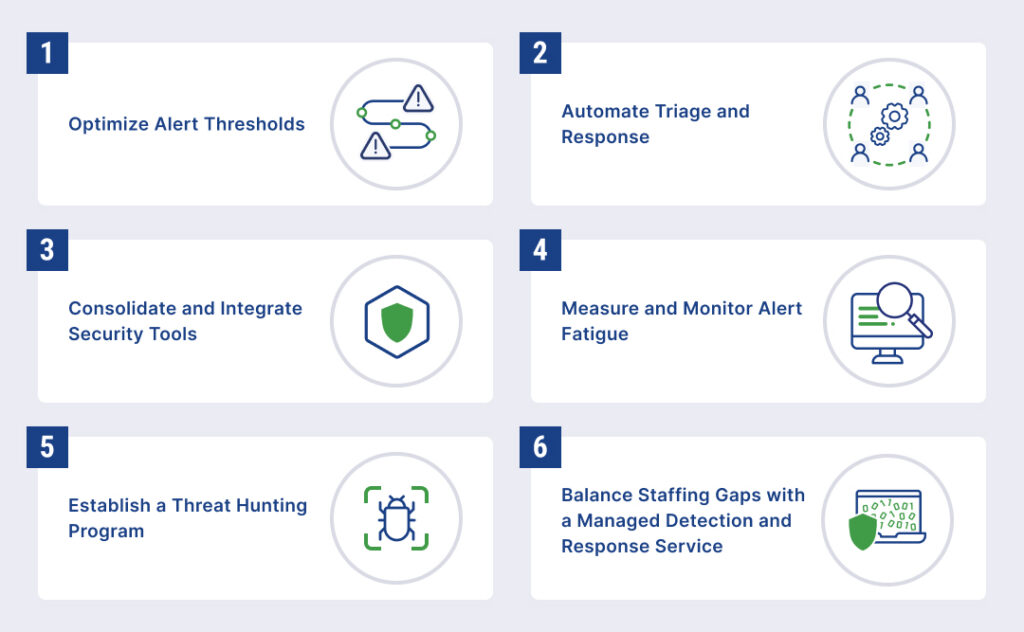
Addressing alert fatigue typically involves multiple coordinated approaches. Here are six best practices to reduce and prevent alert fatigue.
1. Optimize Alert Thresholds
Reducing the volume of alerts analysts have to investigate is the first and most meaningful step organizations can take to quickly reduce alert fatigue. Conduct a risk assessment to calibrate rules around detection to your organization’s risk tolerance, IT environment, and threat landscape. Setting the right thresholds can ensure that only meaningful anomalies will trigger notifications.
Then, establish a hierarchy of alert severity, so your team can mount response protocols based on the potential impact of each threat. Tiered alert prioritization also helps security teams leverage the right communication channels. For example, critical threats can be sent via SMS, while low-priority events may be batch processed and sent in daily digests.
2. Automate Triage and Response
While some suspicious activity may require human response, others can be aptly addressed with automated playbooks. These can resolve low-risk, common incidents instantly, giving team members more time and energy to dedicate to more complex, high-stakes investigations.
IBM reports that artificial intelligence and automation can reduce dwell time by 80 days, lowering average security breach costs by $1.9 million.
For alerts that require human intervention, document what needs to occur. A clear escalation path in a standard operating procedure (SOP) helps outline what team members should do once they have fielded a legitimate, critical alert. This can prevent bottlenecks and delays in addressing an issue by pinpointing who is responsible for what happens next.
3. Consolidate and Integrate Security Tools
Using multiple tools to address security issues can create unintentional silos. Centralizing visibility with a unified tool, like TierPoint’s Adapt Managed Detection and Response (MDR), is essential to eliminate redundant alerts and correlate events across the entire infrastructure. Viewing threats through a single pane of glass can provide historical context and clarity across environments, helping teams differentiate between real threats and noise.
4. Measure and Monitor Alert Fatigue
You may think you’re making progress in reducing alert fatigue, but the best way to know for sure is to track key metrics such as alert volume, false positive rates, and mean time to repair (MTTR). Improvements in these metrics can signal that detection strategies and workflows are becoming more effective, while rising alert volumes or persistent false positives may indicate that analysts are still overwhelmed by noise and that further tuning is needed.
5. Establish a Threat Hunting Program
Reactive threat response can only get you so far. Shifting to a proactive threat hunting approach allows security teams to find and address hidden indicators of compromise before automated alerts even occur. This can require integration with threat intelligence and expert guidance from a managed threat hunting provider that understands how advanced threats can evade standard detection norms.
6. Balance Staffing Gaps with a Managed Detection and Response Service
Internal resources can limit the number of threats security teams can effectively address. Sometimes, teams need to rely on expertise they lack internally, and hiring a full-time employee can be hard to do due to a small talent pool or an insufficient budget.
MDR providers can operate as an extension of your team, handling initial investigations, deploying responses, hunting threats, and helping you improve your security posture overall.
Key Takeaways
Alert fatigue can quietly undermine even the strongest security programs. When analysts are overwhelmed by excessive alerts, critical threats can be missed, response times can slow, and burnout can increase. Reducing alert noise helps security teams focus on the incidents that matter most.
- Consolidate security tools and tune alert thresholds to reduce false positives and redundant alerts.
- Automate repetitive triage, investigation, and response workflows to reduce manual workloads.
- Track metrics such as alert volume, false positive rates, and mean time to respond (MTTR) to identify opportunities for optimization.
Many organizations struggle to reduce alert fatigue because they lack the personnel, time, or specialized expertise required to continuously tune detection rules, investigate alerts, and respond to emerging threats. If your security analysts are spending more time sorting through noise than on strategic security initiatives, an MDR provider can augment your team with automation and around-the-clock security expertise.
Tackle Alert Fatigue with Adapt Managed Detection and Response (MDR)
Conquering alert fatigue requires a coordinated response, leveraging both automated tools and proactive human expertise. TierPoint can help you fulfill both needs. Our Adapt MDR solution equips you with automated threat detection and 24/7 security experts who help you investigate, contain, and recover from breaches quickly – all on a unified platform increases hybrid and multicloud visibility. Learn how Adapt MDR can strengthen your security posture across your IT environment.

FAQs
Alert fatigue in a Security Operations Center (SOC) occurs when a high volume of security alerts comes in with no prioritization, leaving team members bombarded and overwhelmed. This leads to important notifications getting ignored and genuine threats slipping through the cracks.
Security teams can reduce alert fatigue by triaging alerts, tuning thresholds to reduce false positives, and automatically correlating data from across cybersecurity tools. These efforts can limit the amount of notifications team members see and ensure high-risk threats are prioritized first.
Analysts who experience alert fatigue may take longer to respond to alerts, experience high false positive rates, and rush or altogether skip investigation. They may also show signs of burnout, like being detached at work, approaching work from a cynical or frustrated point of view, or withdrawing from collaboration with colleagues.
Automation reduces alert fatigue by helping security teams prioritize, correlate, and respond to alerts more efficiently. Instead of manually reviewing thousands of notifications across multiple tools, security teams can automatically filter out low-risk events, enrich alerts with contextual data, and correlate related activity into a single incident view.
AI capabilities reduce false positive alert fatigue by analyzing patterns, correlating events across tools, and identifying which alerts pose genuine risk. Machine learning models can suppress repetitive, low-value notifications and prioritize high-confidence threats, so analysts can focus on meaningful incidents instead of investigating benign or redundant activity.
Table of Contents
-

Cybersecurity
Jul 17, 2026 | by Matt Pacheco
How to Develop a Ransomware Recovery Plan & Prevent an Attack
VIEW MORE -
Cybersecurity
Apr 30, 2026 | by Ed Mahoney
Cloud Detection and Response Explained: Why CDR Isn’t Enough
VIEW MORE -

Cybersecurity
Mar 31, 2026 | by Ed Mahoney
What Is a Next-Generation Firewall (NGFW)? A Complete Guide
VIEW MORE