


Published: April 30, 2026 | Last Updated: June 11, 2026
Cloud Detection and Response Explained: Why CDR Isn’t Enough

Table of Contents
The idea of a fixed security perimeter is now obsolete. While defending against potential threats once solely meant protecting physical data centers, it increasingly involves safeguarding dynamic cloud environments where identity defines the control plane. For IT leaders, cloud security is now the No. 1 security priority through 2030.
Cloud detection and response (CDR) tools play a key role in addressing modern multicloud threats. However, security teams also need to extend protection across broader IT environments as organizations shift from cloud-first to hybrid strategies.
This article explores the capabilities of CDR solutions, where they fall short, and how managed detection and response (MDR) integrates CDR capabilities while filling the gaps.
What Is Cloud Detection and Response?
Cloud detection and response (CDR) is a security solution purpose-built to protect cloud-native environments. This technology delivers deep visibility, flexible controls, and rapid response that can remediate security threats in the dynamic, API-driven multicloud.
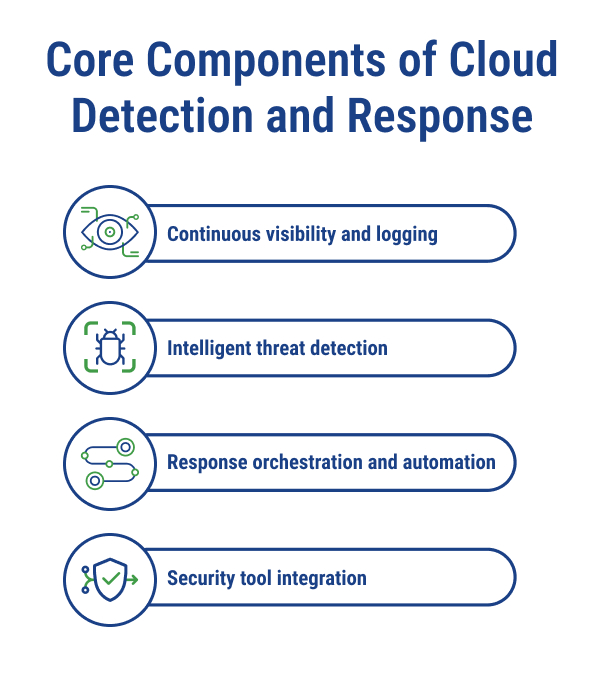
CDR solutions typically include cloud threat detection and response capabilities such as:
- Continuous visibility and logging: CDR ingests and centralizes real-time telemetry from cloud-native sources like AWS CloudTrail, Microsoft Defender, and Google Cloud Audit Logs.
- Intelligent threat detection: Modern CDR solutions use artificial intelligence to distinguish legitimate behaviors from suspicious activity, often by correlating internal logs with external threat intelligence databases.
- Response orchestration and automation: CDR can automate response workflows with prebuilt playbooks and runbooks. Machine learning models can further learn and adapt responses to complex, anomalous attacks.
- Security tool integration: CDR can work alongside existing cybersecurity tools, like security information and event management (SIEM) software, to further strengthen your defense posture.
What Is the Difference Between EDR, NDR, and CDR?
Endpoint detection and response (EDR) focuses on endpoints like mobile phones, laptops, and servers, with device-level monitoring that limits visibility into the wider cloud environment. Network detection and response (NDR) focuses on network traffic and data in transit between devices. CDR operates on the cloud plane, providing visibility into public cloud infrastructure, configurations, and workload activity.
CDR complements NDR and EDR by covering the parts of multicloud environments they cannot see, but visibility into more complex hybrid environments is limited with all three.
What Are the Benefits of Cloud Detection and Response Solutions?
Traditional security tools fall short in cloud environments because they aren’t built to cover a decentralized, expanded attack surface. CDR addresses rising cloud threats, including identity-based attacks, misconfigurations, API abuse, and lateral movement across cloud services.
Organizations that exclusively use cloud platforms, like AWS and Azure, can accelerate response and remediation by using the AI capabilities and multicloud visibility of CDR. They can also reduce alert fatigue by automating triage, keeping security teams sensitive to urgent cloud threats.
What Are the Limitations of CDR Solutions?
While CDR solutions are well-optimized for multicloud systems, cloud detection and response is not a hybrid cloud security tool. Businesses with a mix of public cloud, private cloud, colocation, and on-premises infrastructure can face significant visibility gaps and slowed response times if they rely on CDR alone.
In practice, CDR may detect suspicious behavior within cloud workloads but lack the broader context needed to understand how that activity connects to events elsewhere. For example, CDR solutions can miss lateral movement from the cloud to an on-prem environment, especially since they lack integrated expert analysis to correlate activity and connect the dots. With 46% of organizations adopting a hybrid-by-design strategy, compared to only 10% remaining cloud-first, security teams need broader context to effectively secure hybrid environments.
CDR tools are also often under the purview of teams with non-security skills. Without a centralized Security Operations Center (SOC) at the helm, this can lead to fragmented visibility and slower adaptation to evolving threats.
These gaps are where managed detection and response (MDR) comes in.
How MDR Extends Protection Across Hybrid Environments
Managed detection and response (MDR) is a cybersecurity service that combines artificial intelligence and human expertise to safeguard complex hybrid cloud environments. It integrates the core components of CDR, along with security tooling like EDR and NDR, into one centralized service. For example, TierPoint’s Adapt Managed Detection and Response, includes full CDR capabilities for AWS and Azure while keeping the rest of the hybrid cloud system covered. MDR is also fully managed and monitored by skilled cybersecurity teams.
This delivers a number of benefits beyond CDR:
- Unified visibility across hybrid environments for context-rich threat detection and analysis
- Reduced tool sprawl for consolidated costs and better clarity
- Augmented security teams with 24/7 SOC expertise
The integration of human expertise also means MDR services can help organizations shift to proactive threat prevention, rather than reacting to CDR alerts. You’ll gain access to security experts who can:
- Implement security guardrails tailored to your unique IT environment
- Conduct sophisticated managed threat hunting to uncover potentially malicious activities before incidents occur
- Deliver actionable root cause analyses for continuous security posture improvements.
As cloud platforms become only a fraction of the average organization’s IT ecosystem, comprehensive MDR services will increasingly prove to be an essential alternative to CDR alone.
Strengthen Your Security Posture with Adapt Managed Detection and Response
Mounting a robust response against cybersecurity threats requires a multifaceted approach that spans public cloud, private cloud, and on-premises infrastructure. TierPoint’s Adapt MDR integrates the capabilities of CDR for Azure and AWS, while augmenting existing IT security tools with AI-powered protection and expert guidance in a hybrid environment. Learn more about how we can help you strengthen your security posture today.

FAQs
While traditional on-premises security monitoring requires physical hardware and network perimeters, cloud detection and response takes a more dynamic approach with API-driven environments and building blocks like containers. Instead of geographically based threats, cloud detection and response focuses mainly on identity-based threats, understanding the context of a behavior and determining the level of risk and recommended actions from there.
Security information and event management (SIEM) is used more for long-term storage and compliance regarding security events. CDR is designed for real-time automated responses against threats in the cloud. While SIEM can offer visibility in the cloud, the context is usually richer with CDR.
Endpoint detection and response (EDR) is a service that monitors physical devices, like laptops and cellphones, to spot and address malicious activity. CDR is focused on the entire cloud environment. The main difference is the coverage area and what is being protected – the device versus the infrastructure.
Table of Contents
-

Cybersecurity
Jul 17, 2026 | by Matt Pacheco
How to Develop a Ransomware Recovery Plan & Prevent an Attack
VIEW MORE -
Cybersecurity
Jun 9, 2026 | by Ed Mahoney
Understanding Alert Fatigue and How to Avoid It
VIEW MORE -

Cybersecurity
Mar 31, 2026 | by Ed Mahoney
What Is a Next-Generation Firewall (NGFW)? A Complete Guide
VIEW MORE