


Published: April 22, 2026 | Last Updated: April 27, 2026
What Is a Business Continuity Plan? How to Build Your BCP

Table of Contents
Downtime is now an operational certainty. A business continuity plan (BCP) helps organizations proactively define how critical functions continue when systems, sites, or suppliers fail.
This article will cover what a BCP includes and how to build one that keeps your business operational when it matters most.
What Is a Business Continuity Plan?
A business continuity plan (BCP) outlines the procedures necessary for core business operations to survive when disaster strikes. This may include processes and safeguards to:
- Meet urgent customer needs
- Maintain critical systems and data availability
- Keep your workforce, including remote employees, operational and connected
A comprehensive BCP should include an up-to-date list of redundancies, as well as communication and disaster recovery plans. Final procedures should be designed with your organization’s recovery objectives and critical business functions in mind.
Business Continuity Plan vs. Disaster Recovery Plan
A business continuity plan focuses on keeping the business running during a disruption. A disaster recovery (DR) plan focuses on restoring IT systems and data after an incident.
Disaster recovery is a core component of business continuity planning, providing the technical steps needed to recover IT infrastructure and resume normal operations.
Why Is Business Continuity Planning Important?
The growing severity of disruptive threats, including cybercrimes, natural disasters, geopolitical conflicts, and supply chain issues, are increasing the importance of business continuity planning. According to the World Economic Forum’s Global Risks Report 2026, geopolitical and geoeconomic risks in particular are expected to create instability.
Risks like these can result in costly downtime, reputational damage, and regulatory issues. A well-formed business continuity plan can keep businesses operational, bolster trust, and ensure compliance in the growing and evolving threat landscape.
What Are the Key Components of a Business Continuity Plan?
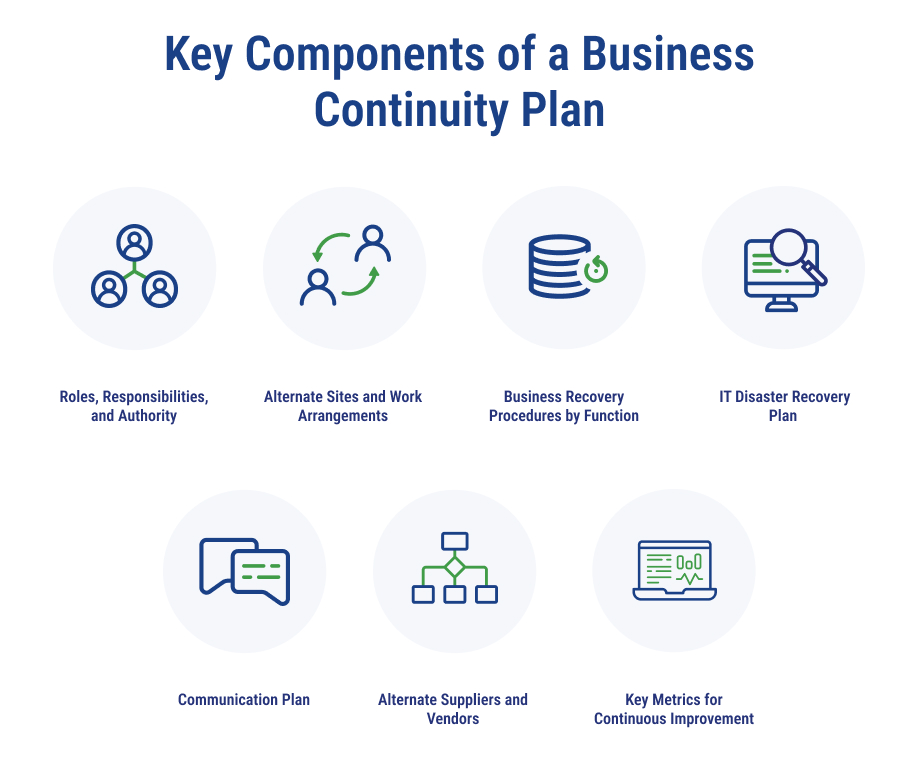
An effective business continuity plan typically outlines roles and responsibilities, work arrangements during disruptions, core recovery procedures, and plans for communicating and securing support from vendors.
Roles, Responsibilities, and Authority
Your BCP should clearly define who activates the plan and who is responsible for each action. Identify a core business continuity team, assign decision-making authority, and include backup roles in case key personnel are unavailable.
Ensure you have up-to-date contact information for all team members, across multiple channels, to support rapid coordination.
Alternate Sites and Work Arrangements
Plan for where and how work will continue if your primary location is unavailable. This may include remote work, alternate sites, and the infrastructure and access needed to stay operational.
Include a contingency plan for staffing gaps, such as support from contractors or managed service providers (MSPs).
Business Recovery Procedures by Function
The core responsibilities of each continuity team member should align with a list of requirements to recover mission-critical business processes for each essential function. This should include step-by-step actions, as well as details such as:
- The necessary resources, including costs, for remaining operational
- Function-specific recovery time objectives (RTO)
- Required documentation, systems access, and credentials
IT Disaster Recovery Plan
A disaster recovery plan is a subset of the BCP that outlines data backup locations, data and system recovery processes, and redundancies your company will use to ensure multiple restoration options.
For small teams or businesses without a specialized DR unit, disaster recovery as a service (DRaaS) can be part of this plan. DRaaS provides end-to-end disaster recovery support, so your organization can achieve high availability and predictable recovery outcomes. Integrating this service is also useful for businesses with highly sensitive information, such as healthcare and finance organizations, that are required to maintain data resilience.
Communication Plan
When an incident occurs, organizations benefit from having a pre-established plan for communicating what occurred. This should include details on who should be contacted – such as employees, customers, vendors, regulators, and the media – for which incidents, when, and by whom. The communication plan can also include internal call trees as well as an external contact list and message templates.
Alternate Suppliers and Vendors
Some disasters and outages can involve third-party suppliers and vendors, so it’s also important to include lists of alternates you can rely on. Include key contacts for each alternate, as well as the lead time necessary to make the switch.
Key Metrics for Continuous Improvement
To keep your business continuity plan effective over time, establish metrics to evaluate performance and identify areas for improvement. Regular measurement helps keep your plan aligned with evolving business processes, risks, and operational needs.
Examples of useful BCP metrics include:
- Time since last business impact analysis (BIA), which ensures your plan reflects current critical processes and dependencies
- Critical recovery plan review frequency, which supports ongoing preparedness for key applications and business-critical functions
- Mean time to resolve (MTTR), which tracks how quickly incidents are addressed and highlights opportunities to prevent repeat outages
Organizations can monitor these metrics to continuously refine their BCP, strengthen resilience, and reduce the impact of future disruptions.
How to Create a Business Continuity Plan: 6 Steps
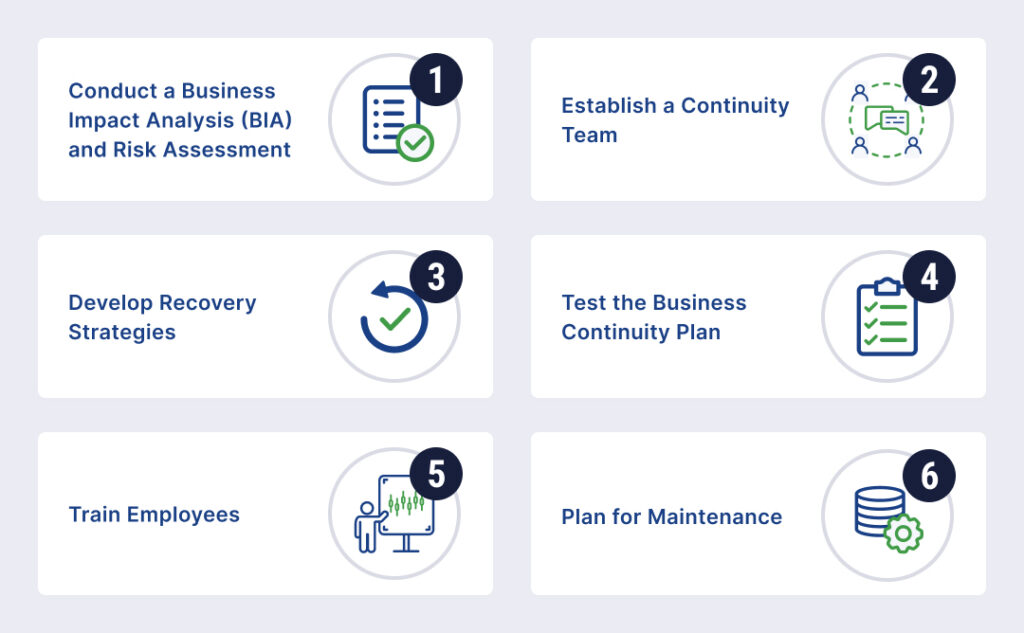
Before you find yourself in a situation that can result in significant downtime and financial loss, follow this business continuity planning process to build your BCP.
1. Conduct a Business Impact Analysis (BIA) and Risk Assessment
Effective business continuity starts with a business impact analysis (BIA) and a risk assessment to understand what matters most and what could disrupt it.
Begin with a BIA to identify your critical business functions and their dependencies. Map the systems, applications, and connections each function relies on, and determine how long your business can tolerate downtime before it impacts revenue, operations, or customer trust.
Next, identify your recovery time objective (RTO), which defines how quickly systems must be restored, and recovery point objective (RPO), which defines how much data loss is acceptable.
Then, perform a risk assessment to identify the most likely threats, from cyberattacks to infrastructure failures, and uncover any single points of failure (SPOFs) that could take systems offline.
This process will help you prioritize business continuity steps. For example, if your ERP system depends on a database and a CRM platform, and the database fails, billing and order processing may stop entirely. If that downtime is costly, you may set an aggressive RTO and implement redundant database infrastructure to eliminate that single point of failure.
2. Establish a Continuity Team
Your continuity team is responsible for putting your plan in motion, and it shouldn’t just include IT staff. Other departments like HR, finance, and members of leadership can be part of this team. To unify processes, you’ll want to have an Incident Commander assigned who can trigger the cascade of business continuity processes automatically, without any additional meetings.
3. Develop Recovery Strategies
Beyond defining backups, your recovery strategy should outline how systems fail over and how recovery is executed in real time.
Start with strong data protection practices, such as the 3-2-1-1-0 rule, which includes immutable or offline backups to protect against ransomware. Equally important is defining where and how workloads recover.
This includes:
- Failover strategies (e.g., secondary site, cloud, or isolated environment)
- Clean recovery environments to avoid restoring into compromised systems
- Orchestration and automation to reduce manual effort during an incident
Detailed runbooks that outline step-by-step actions for specific scenarios should support every strategy. This ensures teams can execute quickly and consistently under pressure, without relying on tribal knowledge or ad hoc decision-making.
4. Test the Business Continuity Plan
A BCP is only effective if it works in practice. Regularly test backups, as well as full failover and recovery execution. You can use:
- Tabletop exercises to walk through roles, decisions, and communication
- Simulations to validate real-world recovery, including failover timing and clean environment restoration
Testing should confirm you can meet RTOs, execute runbooks, and recover without reintroducing risk in different scenarios, like a power outage or data breach.
5. Train Employees
In a disruption, speed and clarity matter. Teams should receive awareness training, as well as up-to-date guidance on how to execute recovery efforts. Ensure staff members know:
- Their role in an incident
- How to access and follow runbooks
- How to communicate using backup channels
Runbooks should be clear, accessible, and role-based, so anyone can step in and carry out critical actions if needed.
6. Plan for Maintenance
Changing staff, emerging threats, and new hardware or software can alter an IT environment and, therefore, a BCP plan. Revisit your plan regularly to ensure it accounts for these changes and make updates when core processes shift.
What Are Common BCP Mistakes?
Even well-documented plans can fail if not everyone is on the same page. Common BCP mistakes include misalignment from the top, lack of testing, training, and updates, and failure to address external risks.
Failing to Align with Key Stakeholders
Your BCP can’t live exclusively in IT. Without buy-in from leadership and department heads, plans stall, funding falls short, and execution breaks down when it matters most.Insufficient Testing and Training
A plan that isn’t tested isn’t guaranteed to work. Regular exercises and training ensure teams can act quickly and confidently during a real incident, not figure it out on the fly.
Treating BCP as a One-Time Project
A BCP is not a one-time project. New vulnerabilities, new intricacies in the business, or new threats in the landscape will necessitate new or altered steps in your plan.
Ignoring Third-Party Ecosystem Risks
While annual reviewing and testing are important, there should also be team members responsible for monitoring vulnerabilities in the IT environment, including the software supply chain. These security experts should also stay informed through threat intelligence feeds.
Build Your Business Resilience with TierPoint
Business resilience requires a comprehensive continuity strategy that you can execute under pressure.
TierPoint helps organizations move beyond theory with business impact analyses and risk assessments that identify what matters most, what’s at risk, and how to prioritize recovery. From there, we help design and implement real-world recovery strategies, including secure failover, clean recovery environments, and operational runbooks.
Whether you’re building a BCP from the ground up or strengthening an existing one, learn how TierPoint provides the expertise to ensure your plan is tested, actionable, and ready when it counts.

FAQs
A business continuity plan (BCP) provides guidelines for what businesses need to do to maintain operations during a disruption that is typically more widespread than what is covered with an incident response plan (IRP), which is more focused on a specific threat and how to identify and address it.
Cross-functional teams lead to the best outcomes for business continuity planning, and can include leadership, IT, operations, legal/compliance teams, human resources, and finance departments. Each of these departments offers unique perspectives that can help craft a more comprehensive continuity plan.
A good rule of thumb is to review, test, and update a business continuity plan annually, but businesses that may have undergone significant changes or deal with more sensitive data may want to do this more often, such as quarterly or right after a large change.
A business continuity plan isn’t a requirement for every business, but it is for many industries, such as finance, government contracting, and healthcare. Other businesses may have this requirement in a less explicitly stated way, such as startups that are beholden to SOC 2 or ISO 27001 certifications.
Table of Contents
-

Cybersecurity
Jul 17, 2026 | by Matt Pacheco
How to Develop a Ransomware Recovery Plan & Prevent an Attack
VIEW MORE -
Data Protection
Mar 16, 2026 | by Scott Good
Future of Disaster Recovery: Key Trends in 2026
VIEW MORE -
Data Protection
Apr 9, 2025 | by Matt Pacheco
How to Protect Against Data Loss with Immutable Backups
VIEW MORE