

Published: October 24, 2025 | Last Updated: June 15, 2026
Healthcare Data Migration Guide for EHR and EMR Systems

Table of Contents
While the days of filing cabinets and paper records are almost completely behind us, many healthcare organizations still operate on legacy IT systems that aren’t the best at meeting modern needs. Today’s patients expect easy access to their complete medical records, and healthcare professionals expect seamless collaboration with other teams and health systems with little to no friction.
Migrating data to cloud-based electronic health record (EHR) and electronic medical record (EMR) systems can help strengthen patient satisfaction scores and operational efficiency while reducing the security risks associated with legacy systems. This guide will cover the key components of a healthcare data migration strategy, including key steps and common challenges.
What Is Data Migration in Healthcare?
Data migration in healthcare involves moving any patient or facility data from one system to another. This may occur as part of a cloud migration, the adoption of new technology, or an IT transition that results from a merger.
During EHR or EMR data migrations, organizations are typically transferring protected health information (PHI). This may include sensitive details such as medications, diagnoses, lab results, billing information, and complete medical histories.
Why Is a Healthcare Data Migration Strategy Important?
A healthcare data migration strategy is an important step in allowing organizations to leverage modern EHR and EMR systems. Doing so can usher in advantages such as:
- Better patient care
- Improved data accessibility
- Increased cost efficiency
- Enhanced scalability and disaster recovery
With careful planning, cloud-based EMR and EHR systems also eliminate data siloes and improve interoperability between departments and facilities. When patients and healthcare professionals receive a centralized view of medical history, providers can make more well-informed decisions, and patients can feel more like they’re in the driver’s seat of their own care. The automations and connections available post-migration can also reduce administrative burdens, helping prevent burnout and improve retention in the healthcare industry.
An EMR or EHR data migration project can also be a core component of larger healthcare IT modernization efforts. For example, when a regional healthcare information organization migrated their workloads to AWS, a seamless data transfer proved essential to achieving their core goals of improved data access, performance, and scalability.
What Are Common Challenges Faced During Healthcare Data Migration?
A well-planned transition ensures that sensitive patient information is transferred securely, seamlessly, and accurately. However, data migrations involving EHR and EMR systems are among the most complex IT projects due to the data sensitivity, structure, and regulatory requirements. Healthcare organizations can run into issues concerning data security, data integrity, compliance, interoperability, data complexity, and downtime that can seriously impede the success of migration projects.
Data Complexity and Volume
The sheer volume of data that healthcare facilities handle makes migration incredibly difficult. In fact, the healthcare industry is responsible for roughly 30% of global data volume. Decades of historical patient data can span terabytes or petabytes, requiring significant time and bandwidth to transfer, often with zero room for downtime in clinical operation.
The complexities involved with healthcare data increase the challenge of migration. EHR and EMR systems contain both structured data (like lab results and medication codes) and unstructured data (like physician notes, scanned documents, and images). Mapping these accurately between old and new systems is difficult, especially when:
- Data formats and fields don’t align
- Free-text data must be parsed or standardized
- Legacy systems use proprietary schemas
Data Security and Regulatory Concerns
Electronic protected health information (ePHI), a common type of data for healthcare providers, is an attractive target for cybercriminals. When a breach involves this sensitive data, it can lead to significant regulatory penalties on top of business disruption, legal fees, and other financial and reputational losses. As a result, healthcare remains the industry with the most expensive data breaches.
Every data transfer must protect PHI through encryption, access controls, and audit trails. Any failure to safeguard data during migration can result in reportable Health Insurance Portability and Accountability Act (HIPAA) breaches and penalties. Organizations also need to abide by standards such as the Health Information Technology for Economic and Clinical Health (HITECH) Act, which expands upon HIPAA by introducing more stringent penalties for non-compliance and formal breach notification procedures.
Preserving metadata like timestamps, authorship, and audit logs is a key step in maintaining regulatory compliance and clinical data integrity. However, effective cloud strategists also drive the adoption of governance frameworks, such as the NIST Cybersecurity Framework or HITRUST CSF, to align regulatory and security practices in the modernized IT environment, increasing auditability.
Data Integrity and Accuracy
Each EHR vendor defines its own method of storing information. For example, your new system may represent allergies, encounters, or lab results differently than your existing vendor. To achieve a successful migration, IT teams must map data fields and coding systems to ensure accuracy in the new system.
Additionally, healthcare organizations must perform data cleansing. Legacy data often contains duplicate patient records, missing identifiers, or outdated entries, which must be addressed before or during migration.
Interoperability Issues
Healthcare organizations can also struggle with interoperability issues during a migration. For example, when patient-related data uses outdated formats in legacy systems, it may not align with modern EHR or EMR standards like the Fast Healthcare Interoperability Resources (FHIR). Misaligned formatting between departments, facilities, and other data sources can lead to misclassification, delayed access to critical patient information, and data corruption.
EHR systems rarely operate in isolation. They also connect to labs, pharmacies, imaging systems, billing systems, and health information exchanges (HIEs). Each integration point must be rebuilt, retested, and validated in the new environment.
Comprehensive data mapping can prevent data loss and workflow friction in each stage of the migration. It’s also important to assess data sharing restrictions before beginning the transition to identify any interoperability roadblocks. Some legacy EHR vendors make it difficult to extract data cleanly or charge for data export services, slowing migration timelines and increasing costs.
Change Management and User Adoption
Migrating an EMR or EHR system impacts clinicians directly. Missing data or unexpected interface changes can delay patient care. These issues can also lead to resistance from staff unless parallel runs, intermediary periods in which the old and new systems remain in use, are well planned. Users accustomed to the old system will need retraining to understand the new workflows, data structures, and reporting processes before the final transition.
Downtime and Disruption
Due to the complexity of medical data migration, healthcare IT experts typically recommend a phased approach. A gradual transition can reduce downtime or disruption, a common migration challenge that can result in delays in patient care, missed opportunities for appointments, and lapses in the billing cycle.
Phased migration can require additional time, as well as two systems running simultaneously. Organizations that want to accelerate the process may choose a big-bang migration, in which old systems are switched to new ones in a single event. However, this method comes with a downside of potential failure without an alternative option to fall back on.
The 6 Best Practices for Securely Migrating PHI Data
When moving to a new EHR or EMR system, healthcare organizations must develop a thorough data migration plan that addresses legal, regulatory, and security risks. This six-step process can support a smooth transition.
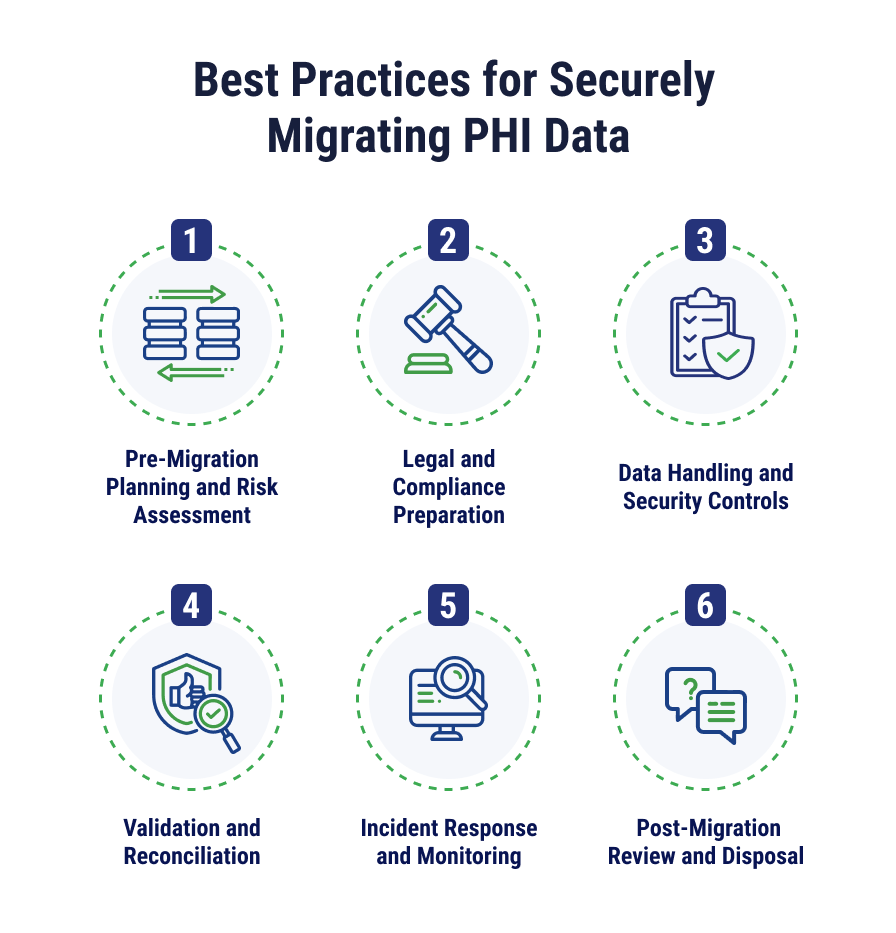
1. Pre-Migration Planning and Risk Assessment
Understanding where PHI resides, who has access, and potential vulnerabilities in the source and target systems is crucial to strengthening data security. Before the migration begins, organizations should conduct a HIPAA risk assessment that includes:
- Data storage locations (on-premises, cloud, hybrid)
- Access controls and user privileges
- Encryption methods
- Network security posture
Once this assessment is complete, it’s important to define your data scope and sensitivity. Determine exactly which data needs to be migrated (including active patients, historical data, and archived records) and minimize scope to reduce exposure risk.
These pre-migration initiatives allow organizations to effectively document a thorough migration plan that includes roles, responsibilities, data flow diagrams, validation checkpoints, rollback plans, and timelines.
2. Legal and Compliance Preparation
Addressing legal and regulatory risks early in the EHR or EMR data migration process can prevent exposure to risk in the present and long term. To start, ensure Business Associate Agreements (BAAs) are in place with all vendors, consultants, and cloud providers who will access PHI during migration. These legal contracts ensure all parties will properly handle sensitive information.
Next, confirm that both the source and destination environments meet HIPAA’s Security Rule (45 CFR Part 164 Subpart C) and Privacy Rule requirements, supporting your HIPAA and HITECH compliance.
For healthcare organizations, audit readiness is also crucial to successful cloud modernization. Document every phase, including data mapping, testing, validation, and final sign-offs, to demonstrate compliance in the event of an audit.
3. Data Handling and Security Controls
Cloud strategists must play an active role in safeguarding PHI. In addition to assessing vendors, it’s important to maintain sufficient encryption during data migration:
- At rest: Use AES-256 encryption or stronger
- In transit: Use TLS 1.2+ for all transfers (e.g., SFTP, HTTPS, VPN tunnels)
- Avoid using unencrypted removable media
If temporary storage or transformation environments are used, they must also be HIPAA-compliant and encrypted. For test migrations, leverage data masking, which replaces PHI with synthetic or de-identified data, wherever possible to prevent unnecessary exposure.
Establishing robust identity and access management (IAM) practices is also foundational to securing migrated data. As part of IAM, healthcare organizations should:
- Leverage the principle of least privilege (PoLP), ensuring end users can only access the data and applications they need to complete approved tasks.
- Implement multi-factor authentication (MFA), which can include time-based one-time passwords and biometrics, such as fingerprint scans or facial recognition.
- Monitor and log all data access for easy auditing.
4. Validation and Reconciliation
Data quality issues can slip through the cracks. During and after migration, IT teams should conduct data integrity testing and validation to verify that no data corruption or loss occurred. Compare record counts, checksums, and random record samples.
Access testing is equally important. Healthcare organizations must validate that PHI permissions and access controls work as intended in the new environment. Immutable audit logs of migration actions also ensure traceability in the event of issues.
5. Incident Response and Monitoring
Developing a migration-specific incident response plan can further secure PHI as the transition occurs. Strategists can identify procedures for detecting, containing, and reporting a data breach if it happens during migration. Real-time, continuous monitoring for unauthorized access, failed transfers, or suspicious activity using Security Information and Event Management (SIEM) tools or cloud-native security solutions can also strengthen security posture.
6. Post-Migration Review and Disposal
When the transition to the cloud computing system is complete, organizations should conduct a post-migration HIPAA compliance validation and update documentation accordingly. Then, educate healthcare staff on how to handle PHI in the new system, emphasizing security and privacy responsibilities.
Once teams are fully utilizing the new software, it’s time to securely decommission the old EHR or EMR system. Wipe drives, destroy physical media, and sanitize old servers that contained PHI according to NIST SP 800-88 guidelines to ensure continued compliance.
Achieve a Seamless Healthcare Data Migration with TierPoint
Healthcare data migration is an inherently complex process due to the stringent HIPAA regulations, massive data volumes, and evolving security requirements that organizations face. But with the right strategy, healthcare providers can modernize systems and strengthen the patient experience while minimizing risk.
A comprehensive data migration roadmap accelerates your journey to maximum visibility and interoperability. This can eliminate silos, simplify compliance, and drive innovation. Clinicians gain timely access to the information that drives better outcomes, while your entire organization experiences reduced downtime and stronger data governance.
When you’re ready to make the transition, TierPoint brings the healthcare IT expertise and compliance assurance to help you reap the benefits of modernization. Our team helps you build a HIPAA-compliant roadmap, execute a secure migration, and manage your modernized environment with confidence. Discover how our ongoing support helps you focus on advancing care, not managing infrastructure.

FAQs
Electronic medical records (EMR) are digital medical records that a single provider uses for a patient, whereas electronic health records (EHR) are comprehensive patient health records that can be used across providers and healthcare organizations.
The 7 Rs of data migration are rehost (lift and shift), replatform (lift and reshape), refactor or rearchitect, repurchase (drop and shop), relocate (hypervisor-level lift and shift), retain, and retire. They describe the different approaches an organization may take when carefully planning a data migration project.
The timeline for a healthcare data migration can vary widely depending on the scope, data volume, system complexity, and compliance requirements. On average, a small to mid-sized healthcare organization may complete a migration in 3-6 months, while large health systems or multi-facility networks with extensive EHR/EMR data and third-party integrations can take six months or more.
Table of Contents