

Published: July 22, 2026 | Last Updated: July 22, 2026
Top 11 DevOps Best Practices You Should Know

Table of Contents
The DevOps model keeps software improvements swift and timely, with fewer defects and lower operational risk. Capturing its value requires a strategic approach. The most important DevOps best practices today include implementing CI/CD pipelines, adopting agile project management, automating infrastructure provisioning, and building a collaborative culture
As software releases accelerate and customer expectations rise, mature DevOps practices can provide a competitive advantage. IT leaders are prioritizing adoption; the DevOps market is expected to grow more than fivefold between 2026 and 2034. This guide explores 11 best practices to help you speed up time to market and drive innovation.
Key Takeaways
- DevOps combines people, processes, and platforms to accelerate software delivery while improving application quality and reliability.
- Successful DevOps adoption depends as much on culture and collaboration as it does on automation and technology.
- CI/CD, infrastructure as code, observability, and continuous testing help teams deliver software faster with fewer errors.
- The right DevOps strategy and tooling create the scalable foundation organizations need to support cloud modernization, AI adoption, and long-term business growth.
What Is DevOps?
DevOps is a software development methodology designed to speed up application changes and reduce errors by combining software development processes (Dev) and IT operations (Ops). Efficiencies come from automation and monitoring being brought together throughout the application development process. The best DevOps team can deploy faster and instill more faith in end users. Plus, with the operations team involved, end business objectives are considered along with testing.
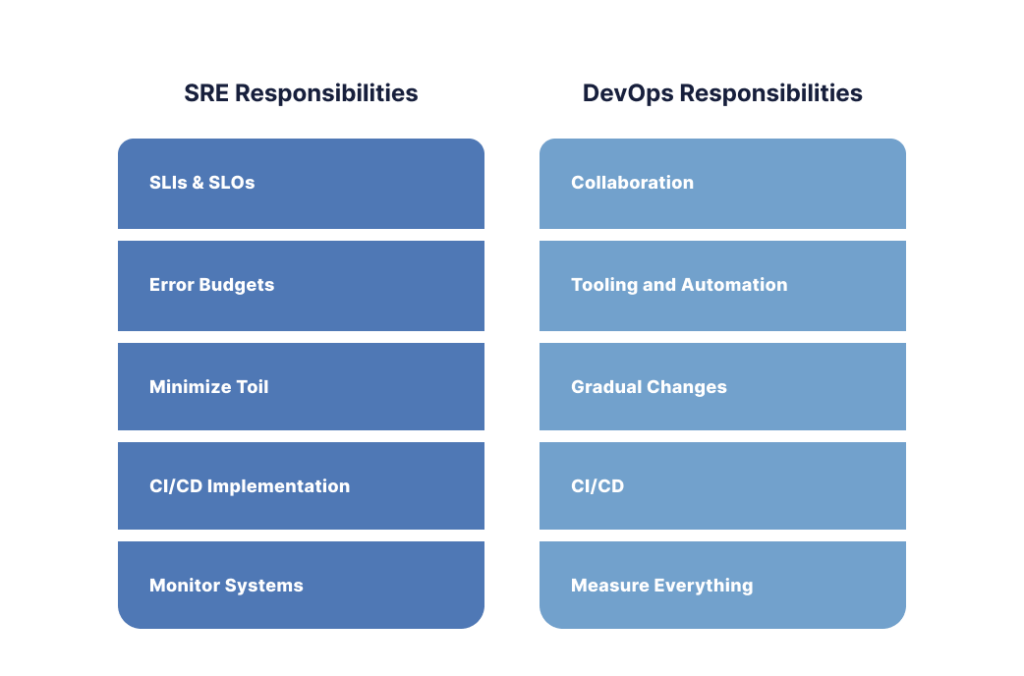
Some businesses may choose to have a DevOps team and a site reliability engineer (SRE) team. An SRE team is responsible for operational functions – monitoring systems, implementing the CI/CD pipeline, and designing systems for the DevOps team to use. In contrast, DevOps teams are focused on removing barriers between the development and operations teams with the end goal of creating solutions that achieve organizational goals.
What Are the Three P’s of DevOps?
The three P’s of DevOps are people, processes, and platforms. When you align skilled teams with standardized, automated workflows and the right technology stack to support continuous integration, delivery, and monitoring, you can reap the benefits of DevOps. Organizations can accelerate software delivery, improve collaboration, and deliver more reliable applications.
Why Is DevOps Important?
DevOps plays an important role in fostering collaboration by breaking down barriers between the development and operations teams. When set up properly, a DevOps team can accomplish more in a shorter time frame than two distinct teams implementing a more divided chain of command. By engaging in this cultural shift, businesses can see improvements in agility, teamwork, data quality, and business value.
Here’s how Jim Bugwadia, co-founder and CEO of Nirmata, explains how this collaborative culture fosters accountability:
DevOps also paves the way for innovation. In fact, 70% of organizations agree that DevOps maturity significantly improves their AI implementation success. A strong DevOps foundation provides the scalable, automated operating model needed to deploy and AI applications while accelerating software delivery and reliability.
Implementing DevOps at scale? TierPoint can help.
TierPoint’s advisory team helps mid-market organizations adopt DevOps, from strategy to automation, without disrupting existing hybrid cloud operations.
Our Top 11 DevOps Best Practices for Implementation
Building a strong DevOps practice at your business requires culture change, automation, and a significant investment in technology. Implementing these 11 best practices can move your teams from siloed to in sync.
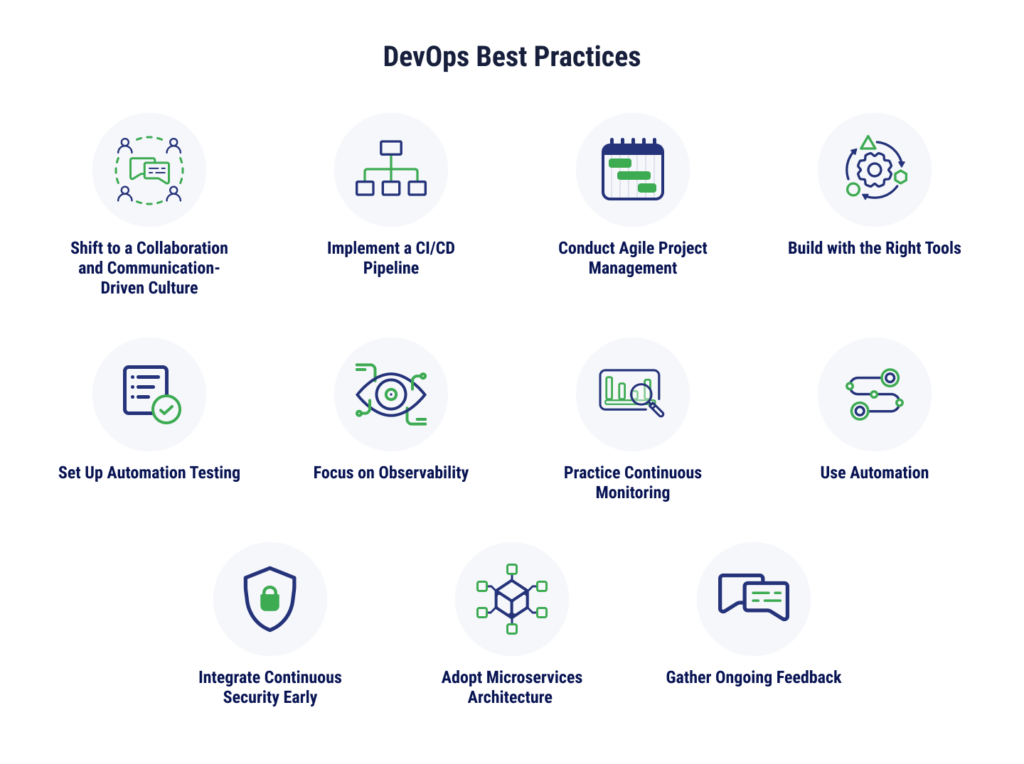
1. Shift to a Collaboration and Communication-Driven Culture
A DevOps migration strategy is just as much about setting new cultural team expectations as it is about making sure the technology and tools are right for the job. Encouraging regular meetings, setting up knowledge-sharing sessions, and creating shared goals can help shift a separated environment to one that thrives on collaboration and communication. Create shared communication channels, pair members of each team together to learn from one another, and have regular stand-up meetings to start making connections and moving toward work as a unit.
2. Implement a Continuous Integration/Continuous Deployment (CI/CD) Pipeline
A continuous integration/continuous deployment (CI/CD) pipeline involves regularly making updates to a software application with the goal of iterative improvement.
By adopting a CI/CD approach, teams can reduce the risk of introducing bugs or errors into the codebase, as small changes are tested and deployed incrementally. This iterative approach to development promotes faster feedback loops, enabling teams to respond promptly to customer feedback and market demands.
Moreover, CI/CD pipelines enhance collaboration and transparency within development teams, as everyone has visibility into the status of code changes and deployments. This fosters a culture of continuous improvement and innovation, driving the delivery of high-quality software that meets the evolving needs of customers.
3. Conduct Agile Project Management
Up the productivity of your DevOps team by implementing agile project management frameworks or technologies, such as Scrum or Kanban. Use boards to visualize what needs to be done, what’s currently in progress, and what’s getting in the way of finishing parts of projects.
4. Build with the Right Tools
The more you can use tools, including artificial intelligence or machine learning capabilities, that integrate easily with your existing systems, the more likely it is that the DevOps team will embrace them. Not only can these tools improve the project management process, but they can also package applications, automate regular tasks, check for errors, and streamline workflows.
5. Set Up Automation Testing
Companies need swift and timely product improvements to maintain customer satisfaction and loyalty in today’s competitive landscape. Automation testing plays a crucial role in this process by allowing organizations to identify and fix bugs quickly, ensuring that new applications are developed efficiently and delivered to market faster. By automating repetitive testing tasks, companies can increase testing coverage, improve accuracy, and accelerate the release cycle, ultimately enhancing the overall quality of their products and services.
6. Focus on Observability
Especially in the early days of a new DevOps team, visibility is key. By visualizing system metrics through effective monitoring, logging, and tracing practices, the team gains invaluable insights into the performance and health of their applications and infrastructure. This visibility and transparency not only enable swift detection and resolution of issues but also fosters a culture of continuous improvement. The team can collaboratively work towards shared goals, ensuring optimal performance and reliability of their system.
7. Practice Continuous Monitoring
Observability and monitoring work well together. Observability can help illuminate the relationship between data points, while monitoring can alert teams to key data points that may require additional action. Use tools to set up alerts for critical events and constantly monitor your environment for potential performance and security issues. Through continuous monitoring, DevOps teams can proactively address problems before they become an impediment for users.
8. Use Automation
Infrastructure provisioning, deployments, and configuration management can all be automated to reduce friction in your team’s processes.
By automating the provisioning, configuration, and management of infrastructure resources, teams can achieve greater efficiency, consistency, and scalability in their operations. Infrastructure as Code (IaC) tools like Terraform, enable teams to define infrastructure components programmatically, treating infrastructure configurations as code that can be version-controlled, tested, and deployed alongside application code.
Automating infrastructure empowers teams to rapidly adapt to changing requirements, provision resources on-demand, and maintain infrastructure consistency across development, testing, and production environments, ultimately accelerating the delivery of reliable and resilient software solutions.
9. Integrate Continuous Security Early
The earlier security vulnerabilities are caught, the less likely they are to impact your end users. By implementing continuous security scanning and vulnerability assessments from the outset of development, teams can proactively identify and address security vulnerabilities before they pose a risk to end users. Waiting until after deployment to address security concerns can lead to costly and potentially damaging security breaches. By incorporating security checks into the CI/CD pipeline, teams can automate security testing and ensure that security measures are applied consistently throughout the development lifecycle. This not only enhances the overall security posture of the application but also fosters a culture of security awareness and responsibility among team members.
10. Adopt Microservices Architecture
Breaking down applications into smaller pieces can make them easier to manage from a development and deployment perspective. A microservices architecture can also scale more efficiently and boost your agility. Containers and API gateways can be used between microservices for communication and management.
11. Gather Ongoing Feedback
Cultural shifts are never going to be seamless, but taking feedback along the way and adjusting when necessary can make DevOps team members feel heard and allow you to handle emerging issues quickly. Use feedback to improve your tools, applications, and processes, and take input from stakeholders at all levels and steps in the development cycle.
How a DevOps Specialist Supports DevOps Maturity
A successful DevOps transformation requires specialized expertise. A DevOps specialist can help organizations establish the processes, automation, and skillsets needed to scale DevOps practices effectively by supporting:
- CI/CD pipelines: Optimizing build, testing, and deployment workflows, so your team can release software faster with greater consistency, gain visibility and address bugs faster.
- Automation: Applying automation tools, such as infrastructure as code (IaC) and automated provisioning capabilities, into your application environment to reduce manual effort and improve scalability.
- of infrastructure as code (IaC), configuration management, and automated provisioning practices to reduce manual effort and improve scalability.
- Observability and monitoring: Implementation of monitoring, logging, and performance management practices that improve visibility into applications and infrastructure.
- DevSecOps integration: Embedding security controls, vulnerability testing, and compliance checks throughout the software development lifecycle to reduce risk without slowing delivery.
With TierPoint, you can offload your DevOps challenges to our cloud experts who will help you define and develop your strategy, and select the right tools and platforms customized to your unique business needs.
Enhance DevOps Best Practices With TierPoint
If you’re looking to innovate using your existing Microsoft Azure or AWS cloud infrastructure and optimize IT, a DevOps approach can help you:
- Speed up time to market
- Reduce risk
- Improve collaboration
- Experience better consistency
Learn how TierPoint’s DevOps consulting services can help you build, plan, implement, and optimize your DevOps transformation.

FAQs
What are Azure DevOps best practices?
Azure DevOps best practices leverage Azure’s tools to streamline processes, improve performance, and maximize reliability in the DevOps lifecycle. Azure Monitor can keep tabs on the application and infrastructure environment, while Azure Functions can help with scalable microservices architecture. Azure Security Center can centralize monitoring, while Azure Cost Management can optimize spend
What are AWS DevOps best practices?
AWS DevOps best practices focus on automation, consistency, and continuous improvement. Organizations can build CI/CD pipelines with AWS CodePipeline and CodeBuild, manage infrastructure with AWS CloudFormation or Terraform, and monitor performance using Amazon CloudWatch. Organizations can use AWS security tools to fortify security and other cloud-native capabilities to optimize resource utilization.
What are DevOps best practices?
DevOps best practices are a set of cultural, process, and technical principles that help development and operations teams work together to deliver software faster and more reliably. Core practices include CI/CD pipeline automation, infrastructure as code, shift-left security, continuous monitoring, and cross-team collaboration. Organizations that follow DevOps best practices consistently outperform peers on deployment frequency, change failure rate, and mean time to recovery.
What are the seven DevOps practices?
While frameworks vary, seven foundational DevOps practices are commonly cited: continuous integration, continuous delivery, infrastructure as code, monitoring and logging, communication and collaboration, continuous testing, and security integration (DevSecOps). TierPoint’s advisory practice helps organizations prioritize which practices to adopt first based on their existing infrastructure and team maturity.
How do I implement DevOps in my organization?
Implementing DevOps requires a cultural shift that breaks down silos between development and operations before introducing tooling. A common sequence is: (1) establish shared goals and communication channels, (2) implement version control and CI/CD pipelines, (3) automate testing and infrastructure provisioning, (4) add monitoring and observability, and (5) continuously improve based on metrics. For mid-market organizations, working with an experienced DevOps consulting partner can significantly reduce implementation time and risk.
What is the difference between DevOps and Agile?
Agile is a project management methodology focused on iterative software development, while DevOps is a broader cultural and operational framework that extends Agile principles into deployment, infrastructure, and operations. Agile addresses how teams plan and build software; DevOps addresses how that software gets deployed, maintained, and improved continuously. Most mature engineering organizations use both together.
What are the key challenges in adopting DevOps best practices?
The most common challenges are cultural resistance to cross-team collaboration, tool fragmentation across legacy and cloud environments, skills gaps in automation and security, and difficulty measuring ROI during early adoption. Mid-market organizations in particular often struggle with DevOps adoption because they lack the internal expertise to sequence changes without disrupting existing operations. This is where external advisory support adds the most value.
Table of Contents
-

Cloud
Jul 21, 2026 | by Daniil Zaika
Cloud Financial Management: Your Guide to Cost Control
VIEW MORE -
Cloud
Jun 22, 2026 | by Matt Pacheco
Cloud Compliance: Challenges, Regulations, & Best Practices
VIEW MORE -
Artificial Intelligence (AI)
Jun 17, 2026 | by Daniil Zaika
AI in Cloud Computing: Driving the Future of IT Innovation
VIEW MORE