


Table of Contents
AI investments are growing, yet most organizations remain ill-equipped to drive measurable business outcomes from their initiatives. High-quality data is often a missing piece.
AI-ready data is trustworthy, accessible, and backed by comprehensive security and governance guardrails that keep outputs sound. This article will cover what AI-ready data entails, why it matters, and the steps you can take to achieve it.
What Is AI-Ready Data?
AI-ready data is information that is effectively secured, refined, and governed, so AI models can deliver trustworthy, actionable outcomes without additional compliance risks or security vulnerabilities. AI-ready data is supported by governance, access controls, and logging so organizations can understand how it is accessed, used, and protected.
While data labeling and classification are important steps, metadata management is only a small piece of the puzzle.
Why Data Readiness for AI Matters
Data readiness is a key factor that determines if AI initiatives will succeed or fail. When data is accurate and well-governed, it strengthens model performance for better decision-making, user adoption, and total operationalization. Data readiness also protects sensitive information from getting into the wrong hands as more employees leverage AI systems.
What Are the Key Characteristics of AI-Ready Data?
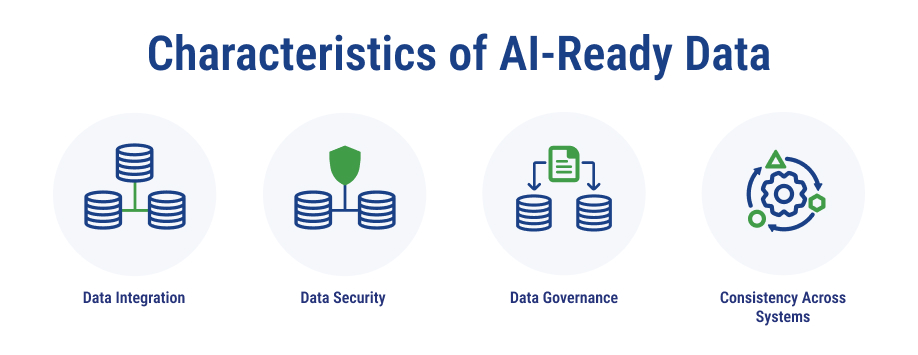
Data is AI-ready when it is well-integrated, managed with consistency, and protected by strong security and governance guardrails
Data Integration
AI scales most effectively when organizations work to unify data, breaking down silos to improve data accessibility and completeness. This can involve platforms such as Microsoft Fabric, which help centralize data discovery, governance insights, sensitivity labels, and policy visibility across Fabric environments.
Data Security
AI adoption can introduce new threats, like data poisoning and leakage, while expanding the attack surface. Organizations must safeguard data with robust cybersecurity measures such as:
- End-to-end encryption
- Immutable backups
- Data activity monitoring
- Next-generation firewalls
- Robust identity management
Data classification can also support AI readiness by helping teams enforce security guardrails, like the automatic masking of sensitive data, that prevent intellectual property and personally identifiable information (PII) exposure in the inference stages.
Data Governance
Beyond security, data governance must support data accuracy and reliability, AI transparency, and regulatory compliance. This creates a solid foundation for trustworthy outputs and responsible AI.
In regulated or high-risk AI use cases, data lineage, traceability, and record-keeping may be required or strongly recommended to support auditability, compliance, and responsible AI practices. Consistent access controls and data policies are also critical. Organizations can achieve this in part by implementing Governance as Code (GaC) to automate policy enforcement.
Consistency Across Systems
Uniform data standards allow data to function consistently across environments, helping AI systems deliver better insights. This can include standardized naming conventions, structured metadata tagging, and regimented labeling across data sources. Consistency is especially important for unstructured data. Without high-quality labeling, AI agents may struggle to accurately interpret or retrieve information.
What Are Common Challenges in Achieving AI Data Readiness?
AI technologies can struggle to perform when organizations try to move pilots forward without solving for the most common data readiness challenges: data fragmentation, governance weaknesses, data quality and scalability issues, and internal skills gaps.
Data Fragmentation
Data silos can prevent the operationalization of AI and create a lack of control over where data goes. Without unification, models work on limited datasets, hindering the effectiveness of AI-driven decisions. Sensitive data sprawl can become a significant compliance risk, as data teams may struggle to apply security policies with consistency.
Lack of Governance
Without robust data governance policies from the start, exposure to compliance and security risks will increase as the datasets grow. It can also lead to data integrity issues that harm stakeholder trust in core AI tools. This distrust can drive up unsanctioned artificial intelligence usage, known as shadow AI, that further limits visibility.
Poor Data Quality
You may have heard the phrase “garbage in, garbage out.” This is true for any organization looking to start new AI projects without assessing the quality of their data. Stale, inaccurate, or redundant data can lead to inefficient AI models at best and, when left unchecked, misleading information or hallucinations that drive poor business decisions. Organizations may even face negative legal or reputational consequences if their models introduce harmful bias and misinformation.
Scalability Issues
Companies working to build AI-ready datasets first need to implement data infrastructure that supports rapid scalability and performance. Some AI use cases require large volumes of data and high-performance infrastructure, while others depend on more secure access to the right governed data. The key is matching the data and infrastructure approach to the use case.
Technical Skills Gaps
People sit at the center of every successful AI project. Organizations need the right in-house or outsourced skills to prepare enterprise data for AI. However, 90% of IT decision-makers say that skill shortages, including data and AI/ML skills, have prevented them from bringing in these new technologies.
How to Get Your Data AI-Ready: 6 Steps
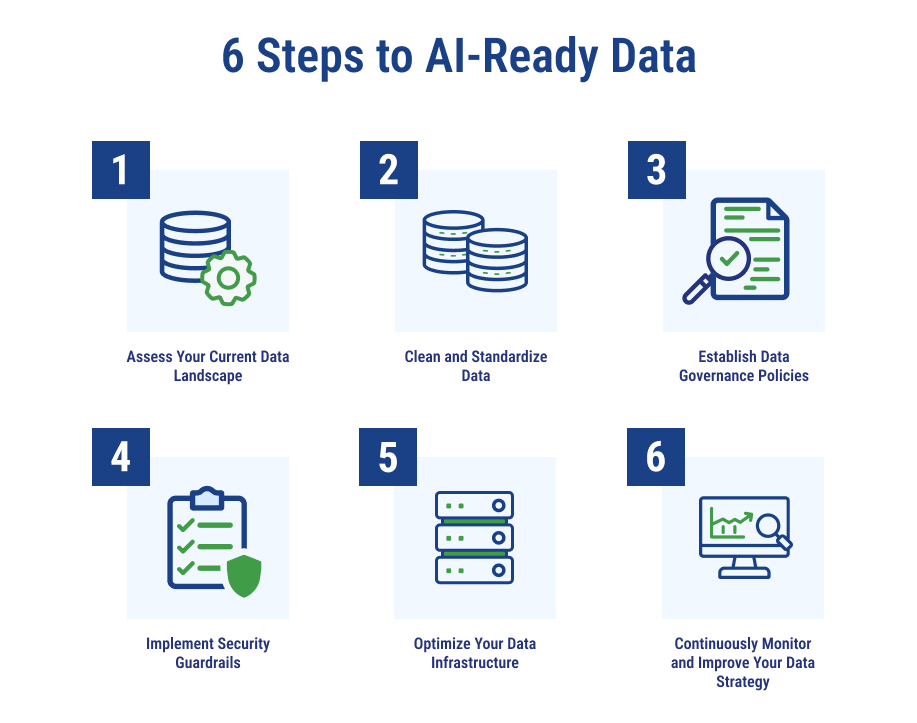
To prevent these issues and get your data AI-ready, follow these six steps.
1. Assess Your Current Data Landscape
Start by auditing your current data landscape to determine where sensitive information exists and who currently has access to it. It’s important to map data provenance at this stage, especially where data is coming from, to confirm that it is legitimate, secure, and authorized.
2. Clean and Standardize Data
Standardizing data is an important part of AI readiness. Data cleaning helps ensure consistent security filtering and improves overall data quality by reducing inconsistencies, outliers, and irrelevant information that can degrade model performance or lead to unreliable outputs.
3. Establish Data Governance Policies
Data governance policies vary depending on industry requirements, regulatory environments, and organizational risk tolerance. At a minimum, organizations must ensure AI systems comply with relevant data privacy and emerging AI regulations, such as GDPR and the EU AI Act.
Effective governance also establishes clear accountability for data and AI systems, including defined ownership of datasets, models, and related pipelines. Additionally, governance frameworks should address model explainability and bias mitigation, ensuring AI-driven decisions can be explained, audited, and evaluated against ethical and compliance standards.
4. Implement Security Guardrails
Protect data at rest and in transit through robust encryption measures and the implementation of Zero Trust principles, including continuous verification, least-privilege access, and strong identity controls for both users and non-human identities. For businesses that store and process PII, add guardrails like automated PII masking to prevent data exfiltration.
5. Optimize Your Data Infrastructure
Security measures shouldn’t hinder performance standards. The right mix of public and private infrastructure can balance AI processing speeds and the ability to audit data interactions with centralized security controls.
6. Continuously Monitor and Improve Your Data Strategy
The most well-planned implementations can drift over time, which makes real-time monitoring essential. This monitoring should track data access, security posture, policy adherence, and changes to the environment that could affect AI risk. Your organization should be committed to continuous improvement to best adapt to changing and evolving AI threats and regulatory requirements.
Is Your Data Ready for AI?
AI-ready data is only one part of successful AI adoption. Organizations also need visibility, governance, security, and the right cloud or hybrid foundation to scale AI responsibly. Get clarity on where your organization stands and identify the most important gaps you need to address with our AI readiness guide.

FAQs
Data is AI-ready when it provides complete, consistent, and trustworthy information for AI models to use. This requires strong governance policies, including strict access controls and lineage tracking, to protect intellectual property or sensitive personally identifiable information (PII) and ensure reliable performance at scale.
Organizations can assess whether their infrastructure supports AI-ready data at scale by evaluating governance, access controls, monitoring, performance, and data locations. It’s also important to look at how consistently policies can be applied across environments to ensure operational success as AI systems scale.
AI agents can process unstructured data, but they require a secure retrieval framework with “least privilege” access to reduce risk. This ensures that they can get the data they need without accessing unauthorized documents or putting out sensitive information within unformatted files.
Table of Contents