


Published: May 1, 2026 | Last Updated: May 7, 2026
Can You Trust Your AI? Why Data Quality Management Is Key

Table of Contents
The phrase, “garbage in, garbage out,” holds a lot of truth when it comes to AI. The value of artificial intelligence tools is limited if you can’t trust the quality of data that informs it.
To improve AI project success, organizations must fix data quality issues before deployment and establish an ongoing process for optimization. We’ll discuss the importance of data quality management, the main characteristics of data quality, and best practices to achieve it.
What Is Data Quality Management?
Data quality management is a set of practices that ensures reliability and technical integrity of data. It involves continuously evaluating data based on key criteria, including accuracy and completeness, and identifying and remediating low-quality data.
Organizations need data quality management to strengthen data-driven decision-making, especially when using AI for analysis and insights.
Data Governance vs. Data Quality Management
Data governance refers to the strategic and legal framework used to determine an organization’s data policies, compliance, and ownership. It outlines rules for how data should be handled. Data quality management describes the technical implementation that prepares data for operational use.
Both play a critical role in AI implementations. Governance provides the roadmap to consistent outcomes, whereas quality management offers the controls.
“You need to have trustworthy, clean, governed data so that you can get accurate information out to the business for decision-making for their regular processes.”
Sheelu Verma, Director of Data Governance, Cloud & Data Operations at ADT
Why Is Data Quality Management Important?
Data quality management is important because it ensures sound business decisions, especially as artificial intelligence becomes a part of day-to-day operations. High data quality is the foundation of trustworthy AI.
Whether data is used for manual analysis or training AI models, quality management prevents unreliable insights. In turn, organizations can rely on their data to build strategies that:
- Boost customer satisfaction
- Improve operational efficiency
- Meet regulatory requirements
Maintaining clean, well-governed data proactively prevents costly downstream errors.
What Are the Effects of Bad Data Quality?
Bad data quality leads to unreliable insights, inaccurate AI outputs, and model hallucinations. Here are some industry examples that illustrate how poor data quality can lead to real-world consequences when leveraging AI:
- Healthcare: AI models trained on incomplete records may miss life-threatening contraindications, which can lead to improper treatment plans
- Finance: Biased models can create discriminatory lending practices, which can come with substantial regulatory fines and a loss of trust
- Retail: AI forecasting tools trained on incomplete customer data could result in an overstock of unnecessary items and a failure to meet actual customer demand.
- Cybersecurity: A threat detection system without high-quality data may miss early signs of a breach or throw too many false positives, causing real threats to go unnoticed.
What Are the Main Dimensions of Data Quality?
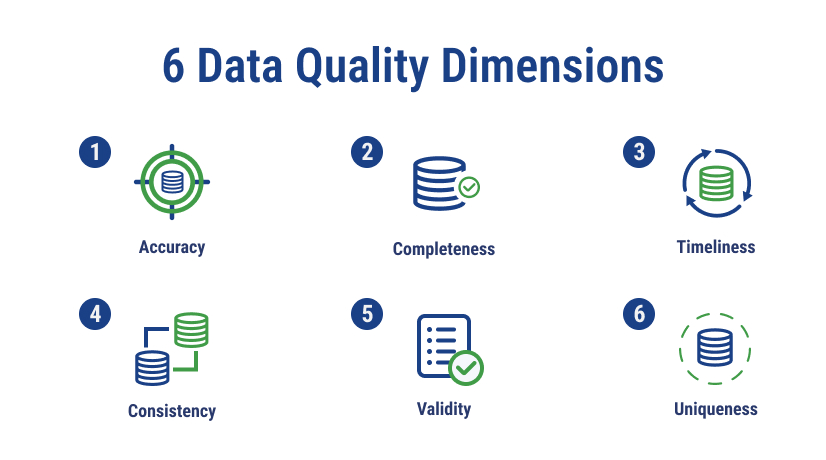
The six main data quality dimensions are data accuracy, completeness, timeliness, consistency, validity, and uniqueness. Meeting these characteristics is crucial to achieving AI-ready data.
Accuracy
Accurate data reflects exactly what it is representing. This means it avoids biased outputs or sharing incorrect or misleading information. If organizations input inaccurate data, this can lead to declining accuracy over time or unreliable outputs.
Completeness
With completeness, all required records and data fields need to be in place to prevent issues associated with fragmented or incomplete data, including flawed analyses and security blind spots. This can be enforced at the governance level, with validation rules that enforce minimum data requirements.
Timeliness
In many use cases, stale data can reduce reliability. Timeliness means that data is up to date, reflecting the current state of the business. Availability is also critical. Data needs to be accessible and up to date for timely use.
Consistency
Data needs to be consistent across different sources, creating a single version of truth. This can streamline workflows and ensure predictable AI model behavior by preventing mismatched records. Consistent data can also support regulatory compliance by ensuring every data set meets high quality standards.
Validity
Validity ensures that data conforms to specific technical constraints and business rules. For example, all fields may need to follow a certain data structure or fall into an acceptable range. Invalid data can impact model integrity, so it should be automatically kept from use in analytics or AI systems.
Uniqueness
Data must also be unique. Duplicate records can add too much weight to model training, leading to skewed results. Teams should clean data to keep duplicates from causing these issues.
What Are Key Aspects of the Data Quality Management Process?
Data quality management includes several distinct processes, including standardization and monitoring, that ensure data meets the aforementioned quality dimensions and is ready for AI models. Each of these practices should align with rules established by overarching data governance standards.
Data Profiling
Ensuring quality starts with data profiling, which involves analyzing existing data formats, content, and relationships to uncover any issue-prone patterns in the data that may exist. This can include structure discovery, which assesses formatting and data types, and relationship discovery, which maps how data sources map to one another.
Data Cleansing
Data cleansing is where teams will remove or fix inaccurate, inconsistent, or corrupt records to ensure accurate analytics. This process can also include data standardization, which focuses on correcting formatting. Organizations use data cleansing to achieve reliable data and improve AI decision-making accuracy.
Data Validation
Teams need to ensure data integrity before information enters the pipeline, and data validation helps achieve this. This practice involves setting rules, like required data types and acceptable data values, to meet regulatory requirements or industry standards. Data that doesn’t meet the standards or shows signs of unauthorized changes is removed from use by both business users and artificial intelligence models, supporting trustworthy AI. Validation often acts as the first line of defense for broader data governance efforts.
Data Monitoring
IT teams can track the health of the data ecosystem in real time using continuous data monitoring. This can prevent security breaches, ensure data availability, and catch quality drift before it poses larger problems. Any deviations need to be flagged and corrected before they create larger issues.
What Are Best Practices for Data Quality Management?
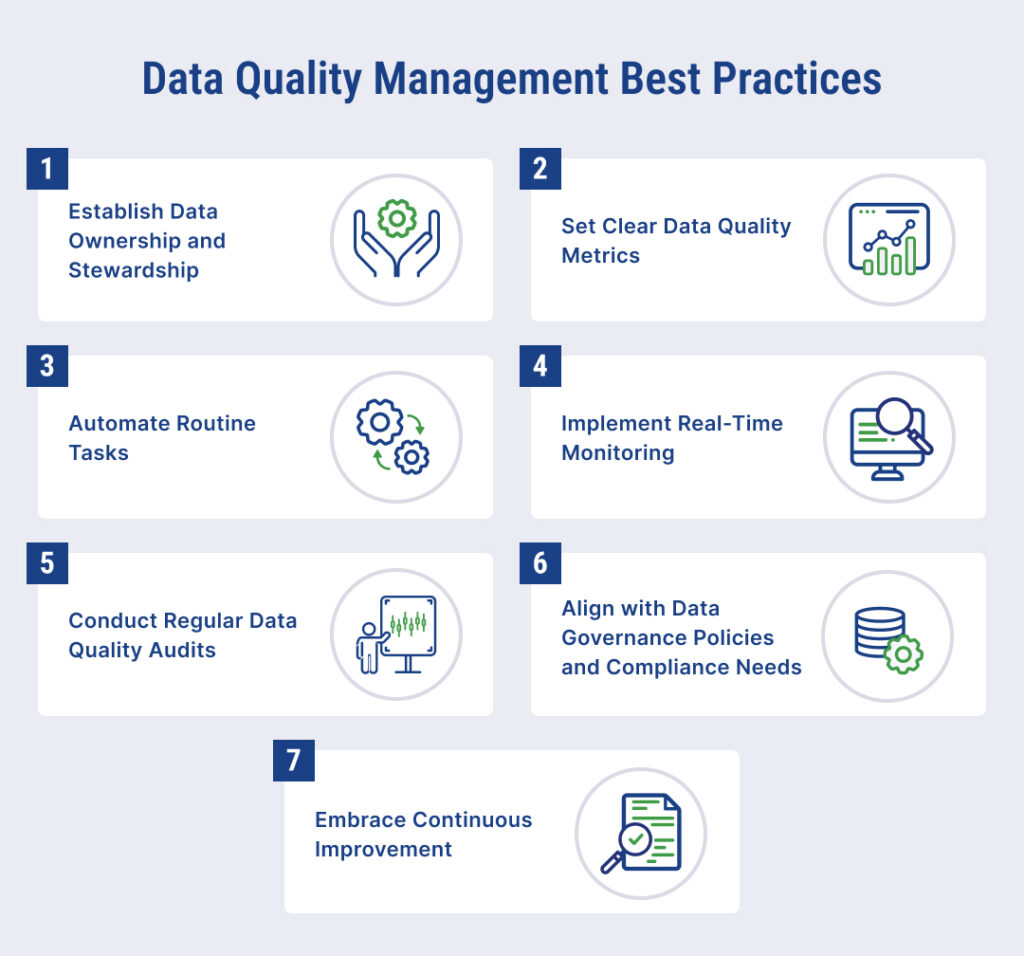
Best practices for effective data quality management include establishing accountability, setting key metrics, automating routine tasks, and aligning processes with data governance standards.
Establish Data Ownership and Stewardship
Assigning a data owner keeps an individual or team accountable for how each data asset is used throughout its lifecycle. The designated owner monitors data assets with security and ethical considerations in mind. This can involve:
- Determining access controls
- Aligning data standards and acceptable use cases with business needs
- Ensuring compliance with data privacy regulations like HIPAA or GDPR
Data stewardship also plays a crucial role in maintaining quality data. Stewards connect strategic governance boards and technical teams, reinforcing policies with operational tasks like data quality monitoring, metadata management, and documentation.
Set Clear Data Quality Metrics
Define and assess measurable key performance indicators (KPIs) that align with each data quality dimension. This can help organizations objectively track quality, set baselines for governance audits, and pinpoint where improvements are needed. Helpful metrics can include:
- Data downtime
- Number of unused tables
- Data freshness and latency
- Total unauthorized access attempts
The right KPIs keep business analytics and AI systems trustworthy by proactively identifying quality drift and potential security issues.
Automate Routine Tasks
Automation can help teams handle high-volume tasks, including those associated with data cleansing and validation. When implemented successfully, these automations can significantly reduce issues stemming from human error while allowing data teams to focus more on broader data strategy.
AI-powered data management can also help identify potential anomalies, risks, and inconsistencies. It can also standardize records at a larger scale, much more quickly than manual methods can.
Implement Real-Time Monitoring
Organizations can also use DQM tools like Monte Carlo and Informatica for centralized, real-time monitoring and automated quality drift notifications. When data quality testing is integrated into the data pipeline, organizations can prevent poor-quality data from training models or reaching the production stage.
Conduct Regular Data Quality Audits
While automated data quality checks can maintain reliable business operations and AI model usage in the short term, it’s still important to perform periodic audits. Comprehensive data quality audits serve as a strong safety net that addresses larger-scale issues and patterns like data debt and missing data security protocols and governance controls.
Align with Data Governance Policies and Compliance Needs
This validation from regular audits is one way organizations can create a trail of compliance that can be shared with regulators if any risks go unnoticed. Data management activity also needs to map to specific regulatory requirements to prevent any legal liability. Data quality efforts must protect sensitive information and provide any necessary transparency required of AI systems.
Embrace Continuous Improvement
Improving data quality is an ongoing process. Organizations should be consistently refining their quality rules and governance frameworks so that data is secure and highly useful to all team members.
Continue Your Path from Data Quality to Trusted AI Outcomes
Improving data quality is critical, but it’s only one part of building trustworthy AI. As organizations continue to embed AI across tools and workflows, understanding how your data is accessed, used, and governed becomes just as important as improving its quality.
Explore how your organization can identify gaps in data visibility, access, and control with our AI readiness guide.

FAQs
Data quality is focused on the integrity and reliability of data, whereas master data management is concerned with the governance around data quality that allows for a single, trusted “source of truth” for the organization. MDM requires data quality to function, but data quality is just one element of MDM.
Data quality management tools are any resources designed to automate processes such as data cleansing, validation, profiling, and monitoring. They help organizations detect errors, enforce consistency, and keep data aligned with regulatory requirements and internal standards for accuracy, completeness, and reliability.
Data quality is typically measured across six key dimensions: accuracy, completeness, consistency, timeliness, validity, and uniqueness. Organizations use quantitative metrics aligned with each dimension, like data freshness and latency for timeliness, for objective assessment. Automated monitoring tools can continuously track these metrics for early identification of data quality issues.
A data quality manager can oversee policies and technical controls to confirm that data is meeting the rigorous standards necessary to generate trustworthy outputs. They will manage tools and workflows that ensure data is compliant, secure, and fit for purpose.
Data quality refers to how accurate, complete, and reliable data is for its intended business use. Data integrity refers to the trustworthiness and consistency of data throughout its lifecycle, including during storage, which requires data to stay protected from unauthorized changes and corruption. Data quality is an operational measurement, while data integrity is more technical and structural.
Data quality has a direct impact on AI model performance. High-quality data leads to more accurate, reliable predictions, while poor-quality data introduces bias, noise, and errors into training. Inconsistent or incomplete datasets can cause models to learn incorrect patterns, reducing effectiveness and potentially leading to flawed or unfair outcomes in real-world applications.
Table of Contents
-

Artificial Intelligence (AI)
Sep 1, 2026 | by Matt Pacheco
What Is a Neocloud? Understanding GPUaaS for AI Workloads
VIEW MORE -
Artificial Intelligence (AI)
Aug 26, 2026 | by Ed Mahoney
AI Cyber Attacks in 2026: Top Threats and Security Strategies
VIEW MORE -
Cloud
Aug 26, 2026 | by Whitney Ewing
What Is Cloud FinOps? A Framework for Achieving Cost Clarity
VIEW MORE