


Published: April 27, 2026 | Last Updated: June 12, 2026
Why Corporate AI Implementations Fail: 6 Key Challenges

Table of Contents
Artificial intelligence initiatives can bring countless benefits to your organization, but the fact remains: Only 5% of AI projects succeed. Many businesses experience corporate AI implementation failure when they overlook common obstacles, like data fragmentation and infrastructure constraints, that hold pilots back.
In working with mid-market organizations to assess and scale AI readiness, TierPoint consistently sees six failure patterns that prevent pilots from reaching production. Learn what to avoid and how to achieve successful, enterprise-wide AI adoption.
What Percentage of AI Projects Fail?
According to MIT’s State of AI in Business 2025, the AI project failure rate is 95%. While most companies have investigated or piloted AI use cases, most initiatives never successfully scale into production.
Failed implementations decrease ROI as significant time, money, and resources go to initiatives that don’t deliver measurable results. Stalled pilots can also drive team members to use unsanctioned AI tools, or shadow AI, to meet functional needs, exposing the business to untrackable security vulnerabilities.
Over time, initiatives stuck in “pilot purgatory” shake the confidence of internal stakeholders, who may feel that IT leadership lacks a clear vision and path to AI ROI.
Why AI Projects Fail

Corporate AI implementation failure can often be attributed to the following six root causes. Oftentimes, more than one of these factors contribute to a project’s scalability issues.
1. Insufficient Data Readiness
Fragmented or poor-quality data can impede progress toward implementation.
Data Fragmentation
Where does data exist in your organization? If it’s siloed and difficult to unify, AI systems may rely on incomplete or fragmented data, leading to unreliable outputs. Fragmented data is also more difficult to govern consistently, leading to incorrect or biased outputs that are ultimately unhelpful and damage stakeholder trust.
Poor Data Quality
When bad data is added into the mix, it’s “garbage in, garbage out.” Poor data quality on the input side will cause poor-quality AI outputs. When quality slides, utility also takes a hit, driving end users to abandon the AI tool.
Low-quality data can include inaccurate, incomplete, inconsistent, stale, and redundant information that is difficult to identify and remedy without strong visibility.
2. Misalignment with Business Objectives
Many organizations are jumping on the AI bandwagon, implementing AI for the sake of AI without giving enough thought to the business outcomes the technology should achieve. When initiatives fail to align with business priorities, like customer experience or ROI improvements, IT teams struggle to gain executive buy-in and demonstrate measurable value.
IT and business leaders must align on how AI will help the organization achieve a clear objective, and any decision-makers who may impact AI investments should be on board from day one.
3. Inadequate Infrastructure
Many AI failures can be attributed to an underinvestment in infrastructure that can handle AI workloads, including massive datasets. Legacy infrastructure can quickly constrain AI projects, whereas cloud infrastructure can help businesses to scale with demand without compromising performance.
Inadequate infrastructure can lead to poor AI performance, user frustration, and abandonment of AI tools before they’re able to gain momentum.
4. Lack of Robust Data Governance
To achieve reliable and consistent performance at scale, businesses need to have strong governance and security measures in place, including a clear responsible AI framework. When companies miss key guardrails, like proper data access controls, or inconsistently apply policies across their AI tools or data infrastructure, risks steadily increase. Operationalizing a poorly governed AI initiative becomes significantly more difficult as the project scales.
5. Limited Visibility
It can be hard to govern AI usage when organizations can’t see how AI tools are making decisions or interacting with sensitive data. With inadequate visibility, AI models operate in a “black box” that hinders decision-making and creates hidden security risks, preventing models from evolving effectively. Unexplainable outputs can also stall progress by limiting stakeholder confidence in results.
6. Technical Skills Shortages
AI expertise is in short supply, as are the foundational cloud, security, and data skills necessary to support it. In fact, our 2030 IT Blueprint report found that 90% of organizations have struggled to adopt new technologies due to these technical skills shortages. Preventing AI implementation failure increasingly requires training from within or outside expertise.
Real-World Corporate AI Implementation Failure Examples
These AI implementation challenges aren’t hypothetical scenarios. They’re real-life roadblocks that organizations have faced when attempting to pilot or fully implement AI technology. As you’ll see in the examples below, failure can even strike for large, well-established companies like Zillow, UnitedHealth Group, and McDonald’s.
Zillow: Predictive Analytics Issues in Real Estate
Zillow used AI to speed up the home investment, only to end up losing $421 million. Without human intervention, its iBuying initiative, an instant offer program called Zillow Offers, was unable to form accurate price predictions that could deliver adequate ROI.
Ultimately, Zillow lacked the right internal skills and governance guardrails to support an effective implementation. The model also operated with insufficient data around repair costs and timelines, greatly reducing profitability.
UnitedHealth Group: Predictive Claims Management Gone Wrong
When attempting to automate the claims management process, UnitedHealth’s naviHealth recommended inadequate length of stay required for patients, leading to insurance denials despite the objection of clinicians and families. This led to a lawsuit that claimed a 90% error rate, as most decisions ended up being reversed on appeal.
A clear lack of governance around how the AI tool should work, including explainability and visibility, was a major problem in this case study.
McDonald’s: AI Chatbot Launched with Security Flaws
Aspiring McDonald’s employees likely thought nothing of using the McHire AI website, but a security vulnerability left the data of tens of millions of applicants exposed. How did this data become an easy target? Bad actors were able to bypass flimsy security measures, guess a password was “123456,” and gain access to records by querying company databases. Email addresses, phone numbers, and names for more than 64 million records were found, showing how poor security guardrails can instantly shut down an AI implementation.
What Are Early Warning Signs of Corporate AI Projects Failing?
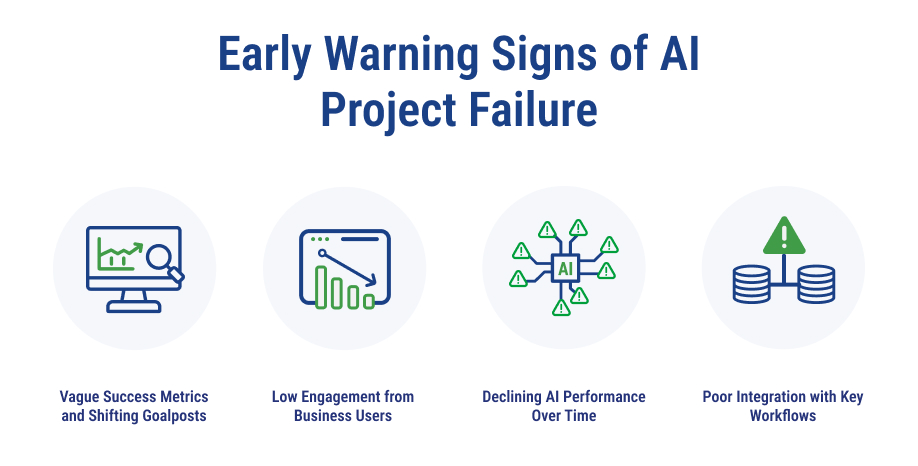
The good news is there are some early signs that can indicate AI failure on the horizon. Spotting these allows teams to course-correct before they reach a point of no return.
Vague Success Metrics and Shifting Goalposts
Maybe you’ve heard members of leadership say they want to “do AI” without much clarity on their ideal AI use case or expectations. Do they even know whether they want to implement generative AI or another type of technology?
Vague success metrics like improving ROI or reducing the time of manual tasks can hint at what the organization wants to achieve while leaving room for unrealistic expectations. It’s important to set specific, grounding key performance indicators (KPIs) and keep these objectives consistent. Shifting goalposts can make it difficult to assess whether a goal has been achieved in full or if there is more work to be done.
Low Engagement from Business Users
A project cannot go from a pilot phase to full implementation without buy-in from team members. If the business users necessary to operationalize AI are not engaged, the initiative will stall indefinitely. This could be due to confusion about the significance of projects, fear among employees that they will be replaced, or opposition to change.
AI implementation leaders should be able to effectively explain the importance of different projects and how they factor into existing roles. If employees see the benefit to these projects, they are more likely to be more engaged. You may choose to start with a few advocates who can test projects and promote them to the rest of their team members.
Declining AI Performance Over Time
AI outputs are only as reliable as the data and oversight behind them. Over time, results can become less accurate or consistent if underlying data changes, access isn’t well controlled, or usage isn’t regularly reviewed. Poor visibility into how AI is interacting with your data creates unnoticed issues that reduce trust, adoption, and decision quality.
Maintaining reliable AI outcomes requires ongoing attention to data quality, access, and governance in addition to the initial deployment.
Poor Integration with Key Workflows
Another common impediment to full implementation occurs when AI pilot projects do not integrate effectively with key workflows. If projects do not operate well with legacy systems, efficiency may not improve enough to reach the key objectives for the project. This can hint at infrastructure issues that must be resolved before operationalization can occur.
How to Achieve a Successful AI Implementation
Organizations can improve the success rate of their AI pilots and implementations by prioritizing high-impact use cases, clear governance policies, strong data foundations, and scalable infrastructure.
Identify High-Impact AI Use Cases and Clear KPIs
Think about the processes that could see immediate, significant improvement with the introduction of AI projects. This could include automating manual tasks for back-office employees, implementing predictive maintenance intelligence on the manufacturing floor, or improving cybersecurity response times with machine learning algorithms that identify and respond to real-time threats.
Establish clear KPIs, such as labor hours, mean time to failure for machinery, and recovery point and recovery time objectives (RTO/RPO) that could prove each AI use case’s success.
Establish Clear AI Governance Policies
Defining and communicating how AI will be used in your organization can help boost employee engagement, prevent shadow AI, and improve adherence to projects with pertinent business objectives. Outline how you will protect data while ushering in new AI initiatives, and identify your main risk areas based on the scope of your projects. You may even want to create a governance board to establish policies and protections for the organization, as well as investigate how AI is currently being used by team members.
Governance policies can also include principles for what your organization will and will not accept when it comes to AI. This can include guidelines around ownership, transparency, bias, and how humans will oversee AI workloads. A robust AI governance framework can build trust in the initiatives and make resistant employees more comfortable with new projects.
Build a Strong Data Foundation
To enable high-quality outputs, it’s important to build a strong data foundation. This should include an overarching data strategy and governance framework, as well as a clear plan for data integration, architecture, and access controls.
Data quality management is often a part of building a solid foundation, as it helps IT teams unify data and ensure there is a single source of truth for AI projects. Even after implementation, businesses should plan to examine the quality of data inputs and outputs and make changes when necessary.
Plan for Scalability Early
It’s never too early to plan to scale a project, since insufficient infrastructure can be one of the main barriers to full-scale implementation. Involve experts early to design the right public or hybrid cloud strategy, which can balance scalability with data protection needs.
Move Beyond Stalled AI Initiatives
Many AI initiatives stall not because of the technology itself, but because of gaps in data visibility, governance, and control. Understanding where these gaps exist is the first step toward scaling AI successfully.
Explore how your organization can identify and address critical gaps with our AI readiness guide.

FAQs
According to MIT research, the failure rate for enterprise AI projects is 95%. This reflects the lack of pilots that enter the production stage.
The biggest challenges in AI implementation often stem from failing to transition effectively from the pilot phase to a larger-scale project due to insufficient data readiness, misalignment with objectives, inadequate infrastructure, lacking governance, visibility issues, and technical skill shortages.
The difference between an AI pilot and full implementation usually comes down to insufficient infrastructure to scale or not enough people in the organization on board to enable it to move beyond the pilot phase.
Table of Contents
-

Artificial Intelligence (AI)
Sep 1, 2026 | by Matt Pacheco
What Is a Neocloud? Understanding GPUaaS for AI Workloads
VIEW MORE -
Artificial Intelligence (AI)
Aug 26, 2026 | by Ed Mahoney
AI Cyber Attacks in 2026: Top Threats and Security Strategies
VIEW MORE -
Artificial Intelligence (AI)
Aug 18, 2026 | by Matt Pacheco
IT Budget Planning: A Strategic Guide for IT Leaders
VIEW MORE