


Published: May 12, 2026 | Last Updated: May 27, 2026
11 Advantages of Cloud-Based AI: Gain an Edge to Transformation

Table of Contents
Cloud-based AI is rapidly improving access to powerful AI capabilities. It delivers highly scalable artificial intelligence services, including the high-performance computing power needed to deploy and manage innovative solutions.
At TierPoint, our experts help businesses leverage these cloud-based tools, designing the right public cloud and hybrid strategies for AI workloads. We’ll explain the advantages, use cases, and challenges of cloud AI services.
What Is Cloud-Based AI?
Cloud-based AI represents the intersection of artificial intelligence and cloud computing. It allows businesses to leverage AI tools and capabilities in the cloud without significant development costs or additional hardware maintenance.
Cloud computing provides on-demand access to high-performance computing resources without the need for physical infrastructure investments. Cloud-based AI, also known as AI as a Service (AIaaS) or cloud AI, expands these capabilities by offering machine learning, natural language processing, predictive analytics, and more ready-to-use services within a convenient cloud environment.
Edge AI vs. Cloud AI
The main difference between edge AI and cloud AI is where the data is processed. Edge deployments process data closer to the source of data generation, whether it’s a user device, Internet of Things (IoT) sensor, or autonomous vehicle. This proximity reduces latency, enhancing real-time processing and the efficiency of AI applications.
However, edge AI is typically not suited for workloads that require large-scale centralized processing or rapid elasticity. Cloud AI is also the best fit for applications that benefit from centralized management, pushing out updates quickly to all users. Businesses can benefit from a mix of both deployments where they fit best.
How Do Cloud-Based AI Services Work?
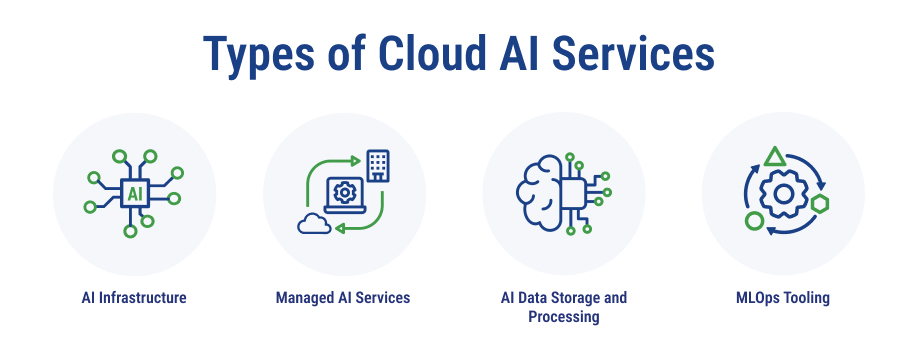
Cloud-based AI services support the training, management, or deployment of AI models, depending on the use case. The core components include AI infrastructure, managed AI services, AI data storage and processing, and MLOps tooling.
AI Infrastructure
High-performance hardware, such as graphics processing units (GPUs) and tensor processing units (TPUs), provide the computational power that enables AI workloads. In the cloud, this hardware is provisioned on demand, with customers typically paying based on usage.
Most cloud providers provide access to GPUs, including NVIDIA-based options. Some providers, like Google Cloud Platform (GCP), also offer their own TPUs, which are designed to accelerate machine learning and deep learning tasks.
Managed AI Services
Businesses looking to leverage AI without building their own models or relying on data scientists can take advantage of managed AI cloud services. Customers can send data to an API and receive instant outputs from a pre-trained model.
These cloud AI solutions are typically purpose-built to meet specific needs. Examples include:
- AWS: Amazon Rekognition for image or video analysis and Amazon Transcribe for instant speech-to-text
- Azure: Azure Document Intelligence for rapid information extraction and Azure Vision for media analysis and optical character recognition (OCR)
- GCP: Gemini Enterprise Agent Platform (formerly Vertex AI) for building, deploying, and governing production-ready AI agents
AI Data Storage and Processing
Cloud AI platforms often include integrated environments for storing and preparing data. Data lakes are commonly used to store large volumes of information, and data pipelines can ingest, clean, and format the data so AI models can use it effectively. Here are some solutions that major cloud providers offer for storage and processing:
- AWS: Amazon S3 for scalable storage and AWS Glue for automated data preparation
- Azure: Azure Data Factory for hybrid data integration and Azure Data Lake Storage for secure data storage
- GCP: BigQuery for high-performance data warehousing and Cloud Storage for storing unstructured files
MLOps Tooling
Machine learning operations (MLOps) tools help businesses accelerate development time and monitor the ML lifecycle. They can track versions of AI models, identify model drift, and automate tasks. Examples of MLOps tools include Amazon SageMaker AI and Azure Machine Learning, which can both help automate deployment and unify workflows.
What Are 11 Advantages of Cloud-Based AI?
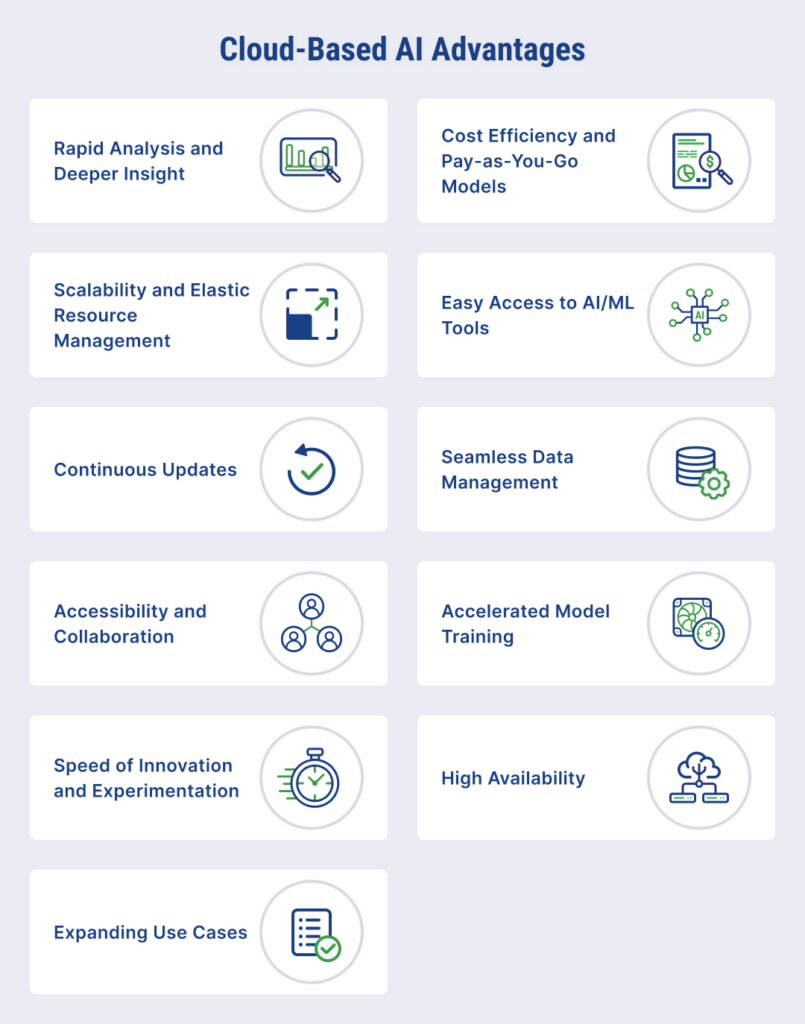
Cloud-based AI can empower businesses to form rapid-fire insights, personalize the user experience, collaborate more effectively, and innovate more quickly to gain a competitive edge. Here are 11 ways cloud-based services can help you stay agile, competitive, and responsive to AI advancements.
1. Rapid Analysis and Deeper Insights
Connecting disparate data sets can be challenging, hindering the ability to glean meaningful insights. Cloud-based AI addresses this by facilitating seamless data integration and rapid analysis.
With the power of AI and the right data management approach, businesses can efficiently process vast amounts of data, identifying trends and patterns that might otherwise go unnoticed. This not only enables real-time decision-making but also empowers organizations to anticipate future needs based on historical data, providing deeper and more actionable insights.
2. Cost Efficiency and Pay-as-You-Go Models
Traditional on-premises hardware and software solutions can come with high upfront costs, with ongoing expenses including maintenance, upgrades, and additional resources to enable scalability. AI tools can compound these costs due to their great demand for computational resources.
Cloud-based AI can improve AI total cost of ownership (TCO) by eliminating the need for massive, upfront capital expenditures in hardware and software. With cloud computing, businesses can access AI resources on a pay-as-you-go basis and allocate financial resources more efficiently.
3. Scalability and Elastic Resource Management
Public cloud environments offer unparalleled scalability compared to traditional on-premises data centers. Businesses can rightsize resources almost instantaneously, rapidly scaling up or down based on needs. This helps protect organizations against overpaying for resources they don’t need. When it comes to AI, where computing requirements can be substantial, scalability is a necessity.
4. Easy Access to AI/ML Tools
Legacy infrastructure can be restrictive and challenging to integrate with modern AI and ML tools. In contrast, cloud computing offers a seamless connection to a wide range of AI resources, connecting businesses to advanced technologies without the constraints of outdated systems. Platforms like Microsoft Azure and AWS further simplify access to AI/ML tools by offering built-in services and tools, like ready-to-use AI agents, that easily integrate with existing cloud workflows.
Cloud computing also aids in the democratization of AI for everyday users. Cloud providers offer a comprehensive suite of AI and ML services, from data analytics and machine learning to natural language processing and computer vision, that empower organizations to innovate and drive digital transformation across departments.
5. Continuous Updates
Businesses can also benefit from the continuously updated AI services and infrastructure managed by cloud computing platforms. Customers can reduce operational overhead and risk by relying on providers to manage security patches, new features, and optimizations.
6. Seamless Data Management
Data access, organization, and storage can be more efficient with cloud-based infrastructure compared to on-premises data centers. Cloud computing can help businesses aggregate and integrate massive volumes of data from different sources, organize it with automated rules, and provide elastic storage options. Cloud providers also offer tools to support data preparation and processing workflows, improving AI readiness.
7. Accessibility and Collaboration
Migration to cloud-based AI solutions can equip team members with access to business-essential applications from any device. Cloud-based AI tools, such as predictive analytics and generative AI solutions, can also help teams brainstorm, coordinate, and reach decisions more quickly than ever before. Businesses of all sizes also gain access to state-of-the-art AI frameworks used at Fortune 500 companies, democratizing access.
8. Accelerated Model Training
Many organizations don’t have access to the scale of compute required to train AI models from scratch. High-performance, scalable cloud infrastructure can help with the training process by providing access to specialized hardware, including GPUs and TPUs that can handle deep learning at scale.
9. Speed of Innovation and Experimentation
Businesses that aren’t looking to build a model from scratch can use pre-built AI services, like image recognition or speech-to-text, and deploy them in minutes. MLOps tools can help teams build quickly, as well as experiment and fail quickly, getting them to the next iteration of their projects in a shorter timeframe.
10. High Availability
With traditional on-premises environments, the failing of a local server can come with hefty consequences. Cloud-based AI services are designed to remain available through redundancy and failover mechanisms. Teams may opt for service level agreements (SLAs) from providers for anywhere from 99.9% to 99.99% uptime, the latter being critical for applications like real-time fraud detection or cybersecurity applications.
11. Expanding Use Cases
The applications for cloud-based AI have expanded quickly in recent years, but more specialized applications are still on the horizon. This can include predictive maintenance, generative design, real-time alerting, intelligent forecasting, automated personalization, optimized supply chains, and more. Use cases for cloud-based AI will continue to evolve to fit changing public needs and satisfy new business objectives.
What Are Some Cloud-Based AI Applications?
Businesses that were once limited by legacy environments can use the flexibility and massive computing power of cloud-based AI to drive new initiatives, such as predictive analytics, customer support, and rapid prototyping efforts.
Predictive Analytics in Financial Services
ML models can use historical data and real-time transaction streams to make predictions with greater accuracy. This can boost fraud prevention efforts, automate financial tips through robo-advisors, and drive more accurate, up-to-date credit risk assessments.
Customer Support in Ecommerce
While some customer concerns require specialized help, many questions and issues can be answered automatically with intelligent chatbots. This allows customer service agents to triage problems and answer more complex questions more quickly, improving satisfaction and reducing response times for all customers across the board.
Rapid Prototyping and Model Training in IT
Training complex models can require hundreds of GPUs. Instead of investing in hardware, businesses can rent computing power to train models, making rapid prototyping more accessible and affordable. The cloud can serve as a flexible environment for experimentation, scaling resources up or down as needed.
What Are Common Cloud AI Challenges?
Before adopting cloud-based AI, businesses should understand potential challenges like data privacy issues, vendor lock-in, latency, and cost management.
Data Privacy, Security, and Compliance
While cloud providers are responsible for some level of data security, businesses still need to establish governance and security guardrails to safeguard business and user data on cloud-based AI platforms. The World Economic Forum’s 2026 Global Risks Report lists adverse AI outcomes as the fifth-highest long-term global risk, rising from 30th in ranking since 2025, while cyber insecurity ranks sixth in short-term global risks.
This underscores the importance of security controls, including automated encryption, data residency controls, and identity and access management (IAM). Another part of governance includes creating internal guidelines around shadow AI. Unauthorized data tools can create leakage, which can be a nightmare for compliance and proprietary company information.
Vendor Lock-in and Portability Concerns
While cloud-based AI platforms offer speed and scalability, they can also create subtle forms of vendor lock-in, especially around the data used to train and operate models. Over time, businesses feed proprietary datasets, prompts, fine-tuning inputs, and usage patterns into specific AI tools. That data, and the way it’s structured within a vendor’s ecosystem, can be difficult to extract, replicate, or reuse elsewhere. This creates a deeper dependency than traditional infrastructure lock-in. Your business intelligence can get tied to a provider, so switching platforms requires retraining. Before AI adoption, consider AI data portability and consider how the right mix of multicloud or hybrid cloud workload placement can support flexibility.
Latency Issues
Many AI applications require real-time responses, including autonomous vehicles, trading decisions, and fraud detection. If there is too much lag between the user and the cloud data center, this can ruin the user experience. Edge computing can help with this, where devices handle some processing while the cloud manages more compute-intensive workloads.
Cloud Cost Management
For those without experience in AI applications, it can be hard to identify all of the hidden costs associated with cloud AI projects. This can include inference costs, or running the model after it has been trained; egress fees from moving data out of the cloud; and costs associated with idle GPUs and other resources. Implementing auto-scaling and leveraging spot instances can help make costs more manageable.
Start Your Journey to Cloud-Based AI
Cloud-based AI can provide scalable infrastructure, access to pre-built services, and flexible pricing models to support AI initiatives. However, success depends on how well data, governance, security, and infrastructure are aligned.
Understanding where your organization stands across these areas is a critical first step before scaling AI. Take our AI readiness self-assessment in our latest whitepaper, The Mid-Market AI Readiness Blueprint, to identify critical gaps and key steps in your journey to fully leveraging cloud-based AI.

FAQs
AI is not inherently cloud-based. Many modern AI applications rely on cloud infrastructure, but artificial intelligence can also run on-premises or at the edge depending on the use case. The right deployment model can depend on factors like performance needs and security requirements.
On-premises AI is deployed within an organization’s own infrastructure, offering greater control and customization. Cloud AI is hosted by cloud providers and delivers greater scalability at a lower upfront cost. The best choice depends on budget, compliance requirements, and operational needs.
Leading cloud AI providers include Microsoft Azure, Amazon Web Services (AWS), Google Cloud Platform (GCP), Oracle, IBM Cloud, and Alibaba Cloud. These providers offer AI and machine learning tools, scalable infrastructure, and cloud services that support a range of AI applications.
Cloud AI is typically priced on a pay-as-you-go model, in which customers are billed based on their exact usage. This is often measured in graphics processing unit (GPU) or tensor processing unit (TPU) usage, API calls made, or “tokens” processed.
Table of Contents
-
Artificial Intelligence (AI)
Jul 15, 2026 | by Matt Pacheco
AI Workloads: Data, Compute, and Storage Needs Explained
VIEW MORE -
Artificial Intelligence (AI)
Jul 6, 2026 | by Matt Pacheco
Understanding AI/ML Use Cases: 12 Examples that Drive ROI
VIEW MORE -
Cloud
Jun 22, 2026 | by Matt Pacheco
Cloud Compliance: Challenges, Regulations, & Best Practices
VIEW MORE