

Published: June 3, 2026 | Last Updated: July 23, 2026
Why Responsible AI Starts with Secure Infrastructure

Table of Contents
Responsible AI is an ethical approach to developing and deploying artificial intelligence. Before it can guide fair, transparent AI usage, organizations need to structure environments, data, and access controls to support responsible AI in practice.
TierPoint helps businesses optimize governance, visibility, and infrastructure for effective AI. We’ll explain what responsible AI means and how organizations can lay the foundations for its success.
What Is Responsible AI?
Responsible AI is a set of principles designed to guide AI development and usage. It provides a framework for aligning AI systems with human values and organizational standards, keeping AI solutions safe and trustworthy.
The goal of responsible AI is to minimize the negative impact of AI technologies, like biased decisions and security vulnerabilities, and maximize the positive.
What Are the Core Principles of Responsible AI?
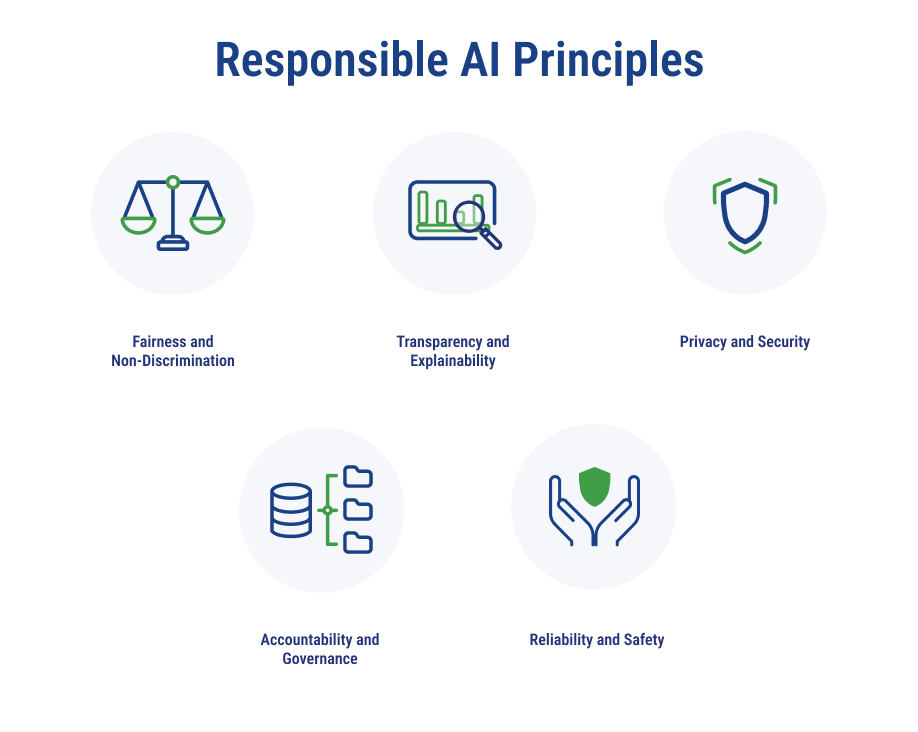
Responsible AI typically centers on five main principles: fairness, explainability, privacy, accountability, and safety. These are core themes seen in established frameworks like the OECD AI Principles and the NIST AI Risk Management Framework.
Fairness and Non-Discrimination
AI and machine learning models are not inherently objective. When organizations power models with unrepresentative or flawed data, AI can magnify biases.
Responsible AI aims to promote fairness and minimize biases as much as possible. This includes ensuring that models aren’t driving discriminatory outcomes. Achieving this requires diverse, representative data and human oversight, which can include regular third-party audits.
Transparency and Explainability
Preventing reasoning errors and ethical issues, including bias, is easier when there’s transparency around how models operate. With greater visibility into how AI systems are used and how decisions are generated, organizations can see why models make the decisions they do and proactively make adjustments. Responsible AI means ensuring that models come with explainability, which provides clear rationale for the decisions they are making.
Privacy and Security
Without proper precautions, AI technology can expose organizations to new threats. For example, in some public generative AI tools, the data you provide may be processed to generate a response, temporarily stored, and used to improve the system, increasing the risk of data leakage.
Responsible AI systems should protect sensitive data and trade secrets and comply with all regulatory requirements. This can involve setting clear standards for training data, prompting, and the use of AI, as well as ensuring that unauthorized users cannot access sensitive information, even with significant prompting.
Accountability and Governance
Assigning responsibility for meeting security, compliance, and other requirements can safeguard against harmful AI outcomes. Organizations can identify an accountable individual or department to be accountable for each stage of AI implementation, usage, and oversight.
AI governance frameworks can guide the accountable parties, adding consistency to internal oversight structures. If you already have governance and risk management guidelines in place, it’s important to update them to address how to handle any additional risks introduced by AI.
Reliability and Safety
An AI model may work predictably under typical circumstances, but abnormalities can lead to issues like nonsensical or harmful results. Maintaining reliability and safety means ensuring AI applications work consistently, even when faced with data quality issues or prompt injection attacks. Responsible AI practices aim to reduce the likelihood and impact of harmful or unexpected outputs.
Why Is Responsible AI Important?
Responsible AI is essential for mitigating harmful AI outcomes, building trust with stakeholders, and preventing costly AI implementation failure.
While artificial intelligence will dominate emerging tech over the next five years, according to our survey of 500 IT decision-makers, many customers and professionals are still skeptical about AI adoption. Pew Research Center reports that 50% of Americans are more concerned than excited about the use of AI in daily life. Ethical concerns around bias, transparency, and accountability are on the rise.
This distrust is raising the repercussions of poor governance. KPMG found that 70% of people are calling for more AI regulation, which can increase the legal, reputational, and financial risks of models gone awry. Biased outcomes and leaked sensitive information or trade secrets can lead to fines, sanctions, and an erosion of public trust.
Businesses that choose to focus on responsible AI can gain a competitive advantage in the form of public trust, consistent AI performance, and effective AI operationalization.
Why Secure Infrastructure and Governance Are the Foundations of Responsible AI
Organizations need secure infrastructure and strong governance to establish the trust, control, and resilience that responsible AI systems depend on.
Governance sets the rules for how AI is used, accessed, and governed within an organization. It introduces accountability with clear policies, access controls, audit trails, and compliance standards. Effective governance also sets guardrails around what data can be used, how it is stored and processed, and how decisions are made.
Secure infrastructure enforces the rules set in place by protecting data, systems, and environments used by AI. This can involve encrypting data in transit and at rest and establishing an incident response strategy when malicious activity is detected on AI systems. The right IT infrastructure strategy offers robust protections without hindering scalability and availability.
Together, secure infrastructure and governance drive consistency, security, and performance at scale for trustworthy AI systems. This is especially critical as AI systems integrate into core business functions.
How to Set the Foundations for Effective AI

Most organizations aren’t starting from scratch with AI. Rapid AI adoption has led to scattered usage, inconsistent access to data, and limited visibility into how AI is being applied across the business.
Achieving consistent, secure AI usage at scale requires strong foundations across governance, data access, and infrastructure. These foundational elements are essential to support a responsible AI strategy in the long term.
Establish Ownership and Human Oversight
Organizations need clear ownership over how AI is used across the business, including who is responsible for monitoring usage, reviewing outputs where appropriate, and maintaining accountability for how AI tools are applied in day-to-day operations.
Without defined oversight, usage becomes inconsistent, and risk increases as adoption grows.
Control Data Access and Usage
AI is only as controlled as the data it can access.
Organizations should establish access controls based on the principle of least privilege, ensuring users and systems only have access to the data they need. This includes both human users and non-human identities such as APIs and AI-driven processes.
Data governance policies should define how data is collected, accessed, shared, and protected, especially when interacting with AI tools. This includes understanding how inputs are handled, whether data is retained, and how sensitive information is managed.
Improve Visibility Across AI Usage
Most organizations don’t have a clear view of how AI is being used across teams. Maintaining visibility into usage patterns, inputs, and outputs where appropriate helps identify risks, inconsistencies, and opportunities for better control. This level of visibility is critical for maintaining consistency and supporting compliance requirements. Without it, AI usage expands faster than it can be governed.
Support AI with Secure, Scalable Infrastructure
As AI workloads grow, it places new demands on infrastructure, from data access and processing to security and performance.
Organizations need environments that can support this growth without introducing additional risk. This includes implementing controls such as encryption, network isolation, and identity-based access, along with monitoring and logging to identify unusual activity.
A secure, well-managed cloud or hybrid environment is essential to supporting AI usage at scale.
Understand Where Your Organization Stands
As AI investments grow, organizations must align with responsible AI principles to achieve consistent business outcomes. However, it’s important to first understand how best practices apply to your environment and set the foundations for effective AI.
TierPoint works with organizations to assess your AI usage, uncovering gaps across governance, data access, and infrastructure that can impact control, security, and scale. Take our AI readiness assessment to identify what’s missing from your foundation, so you can use AI more consistently, securely, and with greater confidence.

FAQs
A responsible AI framework is one that considers how AI can be used safely, fairly, and transparently in an organization, requiring accountability from all responsible parties. You might choose to abide by a specific framework, such as the OECD AI Principles, the NIST AI Risk Management Framework, or the EU AI Act.
The primary goal of responsible AI is to ensure that AI systems are designed and used in ways that are ethical, transparent, and trustworthy. This includes minimizing bias, protecting data privacy, maintaining security, and ensuring accountability for outcomes. Responsible AI aims to maximize the benefits of AI while reducing risks and harm to individuals, organizations, and society.
An example of responsible AI in practice could be a transparent model used in areas like hiring or lending that clearly explains how it reaches decisions and is regularly tested to minimize bias. Designated stakeholders would be responsible for monitoring its performance, ensuring compliance, and addressing fairness concerns.
Ethical AI defines the moral principles and values that should guide AI development, aiming to maximize societal and environmental benefit. Responsible AI translates those principles into actionable controls, processes, and accountability measures that ensure systems are fair, transparent, secure, and compliant in practice.
Businesses that fail to follow responsible AI practices risk introducing bias into decision-making, exposing sensitive data to security threats, and losing control over model performance over time. These issues can erode trust, create compliance risks, and render AI systems unreliable or even harmful in real-world use.
Responsibility for AI is shared across an organization. For example, leadership may set strategy and accountability, while data scientists and engineers build and configure AI systems. IT and security teams can protect infrastructure and data, while legal or compliance teams ensure regulatory alignment. Responsible AI requires coordinated oversight to keep systems ethical, secure, and reliable throughout their lifecycle.
Table of Contents
-

Artificial Intelligence (AI)
Jul 15, 2026 | by Matt Pacheco
AI Workloads: Data, Compute, and Storage Needs Explained
VIEW MORE -
Artificial Intelligence (AI)
Jul 6, 2026 | by Matt Pacheco
Understanding AI/ML Use Cases: 12 Examples that Drive ROI
VIEW MORE -
Artificial Intelligence (AI)
Jun 17, 2026 | by Daniil Zaika
AI in Cloud Computing: Driving the Future of IT Innovation
VIEW MORE