

Published: October 28, 2026 | Last Updated: October 28, 2026
How to Manage Third-Party Security Risks in Your Ecosystem

Table of Contents
Every vendor with direct access to your network can increase your exposure risk. As business ecosystems expand, these connections are becoming harder to monitor and secure. According to the 2026 Verizon Data Breach Investigations Report (DBIR), the amount of breaches involving third parties increased 60% since 2025, now accounting for 48% of all breaches.
Strong vendor security controls can reduce the chance that a compromised partner becomes a pathway into your environment. Learn best practices to mitigate third-party security risks, so your sensitive data and business operations stay protected.
Key Takeaways
- Third-party vendors can expand your attack surface, creating pathways to sensitive information and critical IT systems.
- Assess vendor security, strengthen contractual and technical controls, and continuously monitor third-party access to prevent vendor-originated attacks.
- Extend risk management beyond direct vendors to account for fourth-party (your vendor’s vendor) and broader supply chain risks.
What Is Third-Party Security?
Third-party security refers to the security controls, policies, and risk management strategies that organizations implement to mitigate risks associated with external vendor relationships. These vendors can include suppliers, contractors, and service providers who have access to your IT system, including networks, data, and even physical spaces containing hardware.
Why Is Third-Party Vendor Security Important?
Third-party vendor security is important because external partners can expand your organization’s attack surface. When a vendor has weak defenses, cybercriminals can leverage their third-party access as an entry point to your critical systems and data after a breach.
For most businesses, the potential risks are only growing. Increased reliance on APIs and the public cloud, including SaaS and cloud-based AI tools, has led to more connections between businesses, opening the door to more vulnerabilities. Since 2021, supply chain-related attacks have increased over 431%.
The financial impact is growing as well. IBM reports third-party and supply chain compromise had an average breach cost of $4.91 million in 2025, the second-most expensive type of breach. Additionally, they take the longest to detect and contain at 267 days on average. The financial penalties can be especially high for financial institutions, government entities, healthcare providers, and other organizations that are bound to strict regulatory requirements.
Strong vendor risk management can help reduce breach exposure, limit business disruption, support compliance, and protect customer trust.
How to Mitigate Third-Party Risk in IT Security
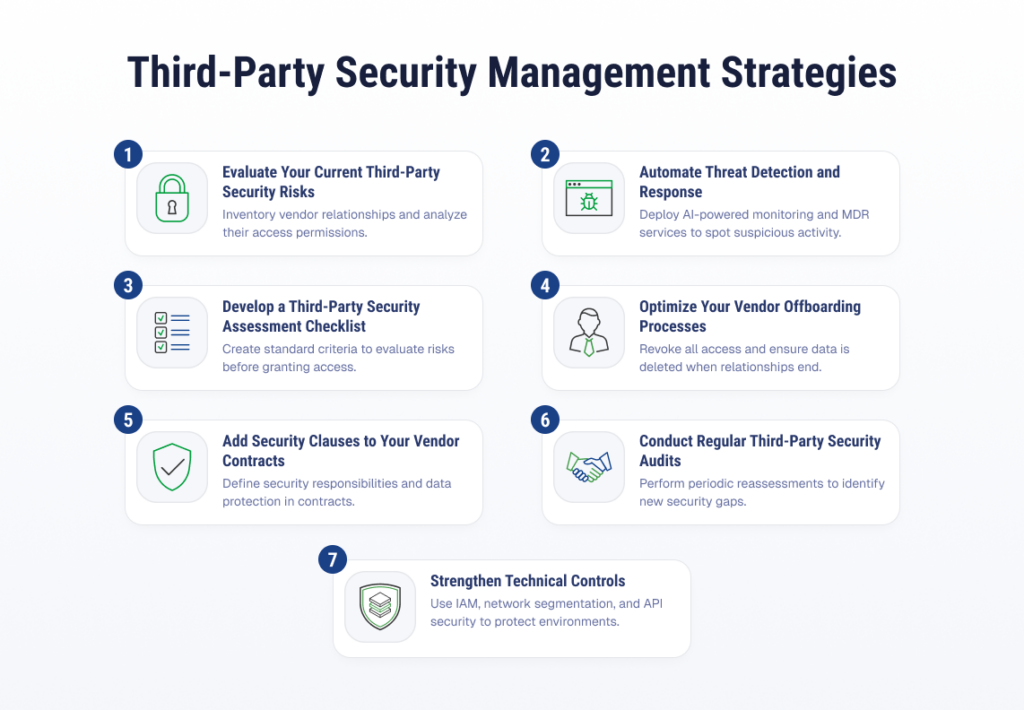
Even small-scale vendor security incidents can disrupt operations, create financial losses and compliance issues, and erode trust. To mitigate risks, organizations need to strengthen their security posture with thorough third-party risk assessments, clear security clauses in vendor contracts, robust security controls, and automated threat detection and response.
1. Evaluate Your Current Third-Party Security Risks
Understanding your potential risk is an important first step in comprehensively reducing your exposure. Use this phase to inventory and assess your third-party relationships. Make note of what vendor access permissions, including:
- Sensitive data access
- File-sharing permissions
- Delegated admin rights
- Shared credentials
- API keys
This practice can help identify vendor accounts with excessive privileges and security weaknesses in how data flows between parties.
2. Develop a Third-Party Security Assessment Checklist
A standardized vendor security assessment can help you evaluate potential risks before granting access or entering into a new relationship. Key questions may include:
- What security certifications and independent audits can you provide?
- How do you encrypt and protect our data?
- Where is our data stored, and do you use subprocessors?
- What access controls do you use to protect client environments?
- How quickly do you detect, report, and respond to security incidents?
- How often do you test your incident response and security controls?
3. Add Security Clauses to Your Vendor Contracts
Before granting vendors access to your systems or data, clearly define each party’s security responsibilities in the contract. Clearly map out security obligations for each party, especially if operating in a shared responsibility environment like the cloud.
Your security clauses may also include:
- Data protection requirements: Define encryption, privacy, and data residency expectations.
- Audit rights: Maintain the ability to review controls, testing results, and relevant security documentation.
- Incident notification: Establish clear timelines and requirements for notifying your organization after a security incident.
4. Strengthen Technical Controls
Organizations cannot solely rely on external vendors to maintain strong security controls. It’s important to protect yourself with additional lines of defense, like identity and access management (IAM), network segmentation, and API security, for a comprehensive approach.
IAM controls can include enforcing multifactor authentication, which requires an additional method for login. It can also include just-in-time (JIT) access, which provides privileges at the moment they are required, revoking them after the session is over.
Network segmentation provides further boundaries on access, placing vendors in a dedicated segment, like a VLAN or a DMZ on the network. Even if their portion of the network is compromised, attackers can’t get to the rest of your environment. APIs can be similarly limited with token rotation, rate limiting, and scope restrictions.
5. Automate Threat Detection and Response
Vendor assessments, contracts, and access controls can reduce risk, but they can’t provide complete visibility into everything happening across your environment. Once vendors, applications, APIs, and other external services are connected, organizations also need a way to continuously detect suspicious activity and respond quickly when threats emerge.
AI-powered threat detection can provide that visibility by continuously monitoring activity, identifying anomalies that may bypass traditional security controls, and helping prioritize the risks that require attention.
Pairing AI and automation with human expertise can further strengthen your ability to identify and respond to threats before they spread. Managed detection and response (MDR) services can extend your internal team with continuous monitoring, expert investigation, rapid response, and remediation support when suspicious activity occurs.
6. Optimize Your Vendor Offboarding Processes
Use a formal offboarding process to revoke accounts, credentials, integrations, and other access when a vendor relationship ends. Confirm that sensitive data is returned or securely deleted and assign clear ownership for each step.
7. Conduct Regular Third-Party Security Audits
Vendor security postures can change throughout the relationship. New tools, personnel changes, expanded access, or shifts in a vendor’s own supply chain can introduce risks that weren’t present during the initial review.
Conduct periodic reassessments based on each vendor’s level of access, the sensitivity of the data involved, and potential business impact. Higher-risk vendors, especially those with privileged access to systems or data, may warrant more frequent reviews.
Regular reassessments can help identify new gaps early and confirm that vendors continue to meet your organization’s security and compliance expectations.
What to Look for in a Managed Detection and Response Provider
MDR is a valuable solution for third-party security management, helping organizations achieve ongoing monitoring and rapid response across environments. The best MDR providers can also identify when threats originate from external parties, so your team can address vendor vulnerabilities fast. Look for capabilities such as:
- 24/7 monitoring and response: AI-powered continuous monitoring and threat management capabilities paired with human-led investigation and response.
- Unified visibility: Monitoring for endpoints, networks, multicloud and hybrid environments, and other relevant attack surfaces to identify threats that might otherwise go undetected.
- Root cause analysis: Remediation processes that identify the source of a threat, such as a specific third-party application.
- Strategic security consulting: Certified consultants to optimize your security controls and strategies for evolving business requirements and emerging threats.
TierPoint’s Adapt Managed Detection and Response combines advanced security technology with experienced analysts who can help you maintain secure third-party collaborations over time.
Secure Your IT Environment and Supply Chain with Managed Detection and Response
Your security visibility shouldn’t stop at the edge of your own organization. Ensure your software supply chain is secure with MDR solutions, which combine human expertise with automated threat scanning and containment to secure all parts of your environment. We can help you address complex risks with a unified, resilient, proactive security approach.
FAQs
How can third-party vendors create security risks?
Third-party vendors can introduce security risks when they have access to your systems, networks, applications, or sensitive data. If a vendor is compromised, attackers may be able to use that trusted connection to gain access to your environment. Regular risk assessments and strong access controls can help reduce this exposure.
What is third-party risk management in cybersecurity?
Third-party risk management in cybersecurity is the comprehensive practice of addressing key risks posed by outside vendors and tools. It involves risk assessments, policy establishment, due diligence, and regular monitoring of associated risks. This approach can lessen security risks and provide greater protection for the organization.
What is fourth-party risk?
Fourth-party risk refers to security, compliance, or operational risks introduced by the vendors and service providers used by your direct third parties. These indirect relationships may be outside your organization’s direct oversight, making visibility into the broader supply chain increasingly important.
How can MDR help reduce third-party security risk?
Managed detection and response (MDR) can help identify suspicious activity associated with vendor access, connected applications, endpoints, networks, and other parts of your environment. TierPoint Adapt MDR combines AI-driven threat detection and automation with 24/7 analyst monitoring and response to help organizations identify, prioritize, and contain threats before they create broader disruption.
Table of Contents
-

Artificial Intelligence (AI)
Aug 26, 2026 | by Ed Mahoney
AI Cyber Attacks in 2026: Top Threats and Security Strategies
VIEW MORE -
Cybersecurity
Jul 17, 2026 | by Matt Pacheco
How to Develop a Ransomware Recovery Plan & Prevent an Attack
VIEW MORE -
Cybersecurity
Jun 9, 2026 | by Ed Mahoney
Understanding Alert Fatigue and How to Avoid It
VIEW MORE